Monday, April 30, 2007

Synecdoche, NY – Part I of II


[Warning: Minor Spoilers]

We knew from the trades (like this article in the
Hollywood Reporter), that Charlie Kaufman would be directing his first film from his original screenplay and that he and Spike Jonze were producing with William Horberg as the Executive Producer. Great. Philip Seymour Hoffman, Catherine Keener, Michelle Williams, Samantha Morton, and Tilda Swinton were in negotiations to star. Double great!

Of this production, William Horberg was quoted as saying,

“It takes the term 'living theater' to a whole new level… We were kind of hoping that Charlie would write a small, contained film set in a kitchen with a couple of easy-going characters. Instead, he came up with a massive undertaking of visually elaborate worlds and stunningly complex characters and ideas. The film would be all but impossible to pull off if we weren't surrounded by such incredible actors, the most exciting team of filmmakers imaginable and the most supportive producing partners one could hope.”

Then buzz about Kaufman’s script exploded when the L.A. Times launched
Scriptland last September. It’s premiere article was penned by Jay A. Fernandez who bragged like a fanboy about how he had the new Charlie Kaufman script on his desk. “I've read it — no, lived it. I've been moved and astounded by it. And I'm tortured by the dilemma of what I should or should not say about it here. I feel a bit like Frodo palming the One Ring.

He went back and forth about whether he should talk about it. He said it made him sick to his stomach. But then he caved in:


Synecdoche nominally concerns a theater director who thinks he's dying, and how that shapes his interactions with the world, his art and the women in his life. But it is really a wrenching, searching, metaphysical epic that somehow manages to be universal in an extremely personal way. It's about death and sex and the vomit-, poop-, urine- and blood-smeared mess that life becomes physiologically, emotionally and spiritually (Page 1 features a 4-year-old girl having her butt wiped). It reliably contains Kaufman's wondrous visual inventions, complicated characters, idiosyncratic conversations and delightful plot designs, but its collective impact will kick the wind out of you.”

In the end, he concluded: “If this film gets made in any way that resembles what's on the page — and with the writer himself directing, it will likely gain even more color and potency in the translation — it will be some kind of miracle. Synecdoche will make Adaptation and Eternal Sunshine look like instructional industrial films. No one has ever written a screenplay like this. It's questionable whether cinema is even capable of handling the thematic, tonal and narrative weight of a story this ambitious.”

News of Jay’s article spread like wildfire across the web, and the man was roundly and thoroughly condemned.
Jim Emerson said: “Fernandez isn't a journalist and he isn't a critic; he's a leech, on the level of those self-aggrandizing amateur web trolls who think their premature, uninformed opinions about an unfinished work are ‘news…’ What a self-serving piece of crap. I have a great idea, L.A. Times: Why don't you go put your Calendar entertainment coverage behind a web subscription wall again?”

Hehehe

Hey, wait a minute. Who are you calling a web troll?

I have three reactions to all of this pre-release controversy:

One: if Kaufman & company didn’t want the script leaked, they should’ve taken better care of protecting their material.

Two: and this goes out to you, Mr. Jay A. Fernandez – you’re a great big dork. You are not special. Media people should stay the hell out of the script leaking/reviewing business. It is most assuredly unethical for a major publication like the L.A. Times, which fancies itself as the “paper of record” on the entertainment business, to make official, critical judgments on unfinished works.

Three: I will agree that fanboys are a very mixed bag. They will reveal every detail in a script, add a small flourish like “it royally kicks ass,” and then call it a “script review.” I’ve also chronicled in my
Indiana Jones 4 article the frustrations that come with following fanboy rumors, because fanboys are quite capable of spreading baseless gossip and calling it “news.” But hey, fanboys will be fanboys. They have every right under the sun to talk about the movies they love and the rumors that interest them. At the same time, it must be said that fanboys aren’t as uninformed as snotty film critics like to think. I still love the time when Sir Lancelot wrote: Lady In The Water is a diarrhea splat of storytelling so haphazard, ideas so undernourished, dialogue so banal, and characterization so criminally lifeless that if you'll be able to lift yourself out of your torpor you will be truly amazed.”

Ya know, I can’t say I disagree.

And let me remind everyone that it was the loud, unified, and venomous anger from fanboys the world over (like in this
article) about the leaked J.J. Abrams’ script of Superman that actually shut down production, which Bryan Singer & company eventually took over. Even J.J. Abrams should be grateful, because his nonsensical story could’ve been the disaster that brought his career to a screeching halt. (At one point in the script, Lex Luthor figures out that he’s from Krypton and FLIES.) This could have been the biggest disaster of a Superman movie since Quest for Peace. All in all, Singer gave us less of a disaster.

Finally, let us be very clear about who we are and what are doing here with our script reviews. We are not fanboys. We are real screenwriters who live and die in the world of “unfinished works.” How well we can pinpoint weaknesses in scripts is crucial. We need a way of discussing the craft, and for us, script reviews are not meant to be “news” or perceived as early reviews of films that haven’t been released yet. It’s just a discussion about craft meant for the consumption of screenwriters only. MY readers are smart enough to know that a script review is just a script review and may not reflect the finished film. And in this context, there is nothing wrong with a serious discussion about the craft like we had for Stanley Kubrick's Napoleon, James Cameron's A Crowded Room, or even The Transformers.

We're all about the craft, baby. If you don't like it, don't read it.

By the way, one of Emerson’s “web trolls,” ZeroC at Ain’t it Cool News,
had this to say about Kaufman’s script: “I really hope Kaufman is able to pull this off… if he can, this may end up being one of the greatest accomplishments in the history of cinema. Either that or a steaming pile of indecipherable, pretentious shit.”

Ya know, informed or not, I agree.

Wednesday, MM’s review of Kaufman’s script. (We'll do the Screenwriting News on Thursday.)

Thursday, April 26, 2007

"Mystery Man? More like Mystery CHILD..."


Hey guys,

Below is just a portion of a recent TriggerStreet review I wrote for a story called Aliens Don't Make Crop Circles. Hope you enjoy it.

-MM

----------------------------

So Kevin and I have "a history."

Over a year ago (has it really been a year?), I reviewed an earlier draft of Aliens Don't Make Crop Circles. Kevin had written in his production notes that he didn't want to bothered by complaints about format, which set me off. In my review, I took the most logical approach to this kind of situation - I ONLY talked about format and refused to provide analysis of story or character or anything else until he cleaned up his script because it looked like @#$%. I believe that was also the review where I had written, "Take heed my advice or fail. I am Mystery Man. Hear me roar."

Hehehe...

Ahh, good times, good times.

So, of course, I received an email from Kevin. The subject heading was "Aliens Don't Take This Lying Down." He wrote: "Mystery Man? Mystery Child could be closer to the mark... I have to say that I did read your review from beginning to end and it was full of wisdom. But what on earth (no pun in this case), are you on? Or, more to the point, what medication are you not taking...? I will explain why I have specifically asked for a no comment on the formatting in the past. It is because some people get so anally fixated with dots and commas that they forget the whole point of the site, to review stories."

And this is true - to a point. Some people certainly can be this way. But to refuse to hear feedback about grammar and format is just beyond absurd. Call me crazy, but "writers" should care about these things. In fact, a writer ought to know how to write, and a screenplay ought to look like a screenplay. The competition is brutal. You're not only competing with thousands of other writers trying to break in but you're also competing with the professionals. You have to excel on every single level. You have to make every scene, every detail, and every word count. You cannot ever and I mean EVER give anyone an easy excuse to dismiss your story or you as a writer. And there's no question that the quickest way to undermine a reader's confidence in you is a wildly gross display of incompetence and ignorance when it comes to format and grammar. In past reviews, I have quoted industry insiders who implore writers to master the craft and study Trottier's Screenwriter's Bible.

Even on my blog, I'll review a "pro" script like, say, "The Transformers," and you better believe that, no different than my reviews here, I'll take them to task for not knowing how to format a screenplay. It's ridiculous that some of these guys get paid gobs of money and they don't know any better than to use archaic techniques that were abandoned four decades ago. Scripts should reflect twenty-first century formatting.

Truth be told, there are a lot of hacks and con artists out there pretending to be "real" screenwriters and they actively bamboozle producers and studios out of enormous amounts of money. They will get hired, write steaming piles of crapola (or get hired to do a rewrite job, change two commas, and turn it in), and then they'll quickly bail when the heat gets cranked up for more rewrites. There's a lot of mistrust on both sides of the fence. Grammar and format is just a first step in a thousand toward proving your sincerity, worth, and legitimacy as a screenwriter.

Okay, okay, stepping off my format soapbox...

Wednesday, April 25, 2007

Screenwriting News! Links! Shout-Outs!


On working with James Cameron.

-------------------------------------------------

Around Scribosphere:

The William Shakespeare Blog-a-Thon! Woo hoo!

Unk’s Transformational Character Arc… Part 9
"CHARACTER BIOS ARE HARD WORK! Can you hear me now? Good! You certainly do not have to live and die by the character bio… And, as I’ve said before… You really only have to go so far on the bio so that the character you’re designing starts talking to you. For some, that might be almost immediately… For others, it might take pages of bio along with pages of history. There are no rules and most likely, there is no one way that will work for everyone."

MaryAn Batchellor’s Writing What You Lean
"How many pirate screenplays have you read where the writer doesn't know his way around a ship, map, or history book? He's just tossing out stuff he's heard in the movies or stolen out of other scripts. Yeah, I know, everyone loves pirate tales right now. Everyone. EVERYONE! But, if you have never read a David Cordingly book ... what? You don't know who David Cordingly is? Then, don't write a pirate story! Don't. Research. Research. Research."

Christina Ferguson’s Perusing Done Deal
"For the past 3 or 4 months, I've gotten in the habit of reading the sales on
Done Deal Pro every weekday. For $23.95 a year, it's a total bargain. It's interesting to see what's being sold and also what's in turnaround. And to read the loglines of rom com projects, since that's where I'm writing lately…"

Maggie’s Crazy Aunt Purl!
She plugs the book of a friend, and the book’s got a great title – Drunk, Divorced & Covered in Cat Hair. Hehehe

Latest picture of Roger Ebert

Girish’s Interweb Explorations

Superb analysis from Matt Zoller Seitz on the new Sopranos
Ep. 13, Ep. 14, and Ep. 15.

My Tarantino Problem, and Yours

Dennis Cozzalio on Grindhouse

David Bordwell’s
But what kind of art?
"Here are the dimensions that come to my mind:
*Film is a photographic art.
*Film is a narrative art.
*Film is a performing art.
*Film is a pictorial art.
*Film is an audiovisual art."

-------------------------------------------------

Around the World:

Continuation of the Most Entertaining Screenplay Trial Ever
"Cussler, who sold the rights for “Sahara” to Anschutz's filmmaking company for $10 million, sued in early 2004, saying the company, then called Crusader Entertainment, violated his contract by cutting him out of the scriptwriting process… To support Cussler's case, his lawyers called former Crusader executive Karen Baldwin, who testified extensively about trying to keep Cussler and a battery of 10 “Sahara” screenwriters happy. Baldwin told jurors she was Cussler's biggest advocate during the lengthy screenwriting process. But in some of her many e-mails displayed in court, she called Cussler's changes to screenplays “crap” and “groanable.” “Didn't you tell Cussler you loved his scripts?” asked Cussler's lawyer Bertram Fields, a veteran entertainment litigator. “Yes, but I always meant it with a qualifier,” Baldwin said. Baldwin later detailed Cussler's assessments of actors being considered to play the lead character, Dirk Pitt, the hero in most of Cussler's books. Among those mentioned were Brad Pitt, who Baldwin said had a “height issue,” and Bruce Willis, who Cussler complained was “balding.” Kurt Russell, Matt Damon and Ben Affleck all got the same grading, Baldwin said: “Clive doesn't think so.” Veteran Hollywood screenwriter David Weisberg, who was brought on briefly to get the script in shape, testified about a meeting with Cussler, describing it as “a very bad date.” At one point, Cussler went on a “diatribe” about Tom Cruise, calling the actor “shrimpy” and using a term questioning his sexuality, Weisberg said."

It’s Not a Sequel, but It Might Seem Like One After the Ads
"That originality is a dying value on the blockbuster end of the movie business is no secret. In the last five years, only about 20 percent of the films with more than $200 million in domestic ticket sales were purely original in concept, rather than a sequel or an adaptation of some pre-existing material like “The Da Vinci Code...” The drift away from pure inventiveness is limited to the industry’s most expensive and commercial films. According to the Writers Guild of America, West, the balance between original and adapted scripts in overall feature film production has remained constant in recent years, with slightly more than half of the screenplays being original... “It’s tragic,” the screenwriter Bob Gale said of what he sees as Hollywood’s lost inventiveness. Missing, he said, is the nonpareil thrill he experienced in creating, with Robert Zemeckis, the early drafts of “Back to the Future,” a 1985 hit provoked by his own question: Would he have liked his own father if he had known him in high school?"

PLAYBILL ON OPENING NIGHT: Frost/Nixon — David and His Zingshot
"Should Langella take the Tony, it would make a triple crown for Morgan, who follows the same guideline as a playwright that he does as a screenwriter — take a person of power, infect them with an Achilles' heel kind of incident and watch them disintegrate. He did it with Idi Amin in "The Last King of Scotland" and with Elizabeth II in "The Queen," making Oscar work for Forest Whitaker and Helen Mirren. Can a Tony be far behind?"

'Deadlines were good enough for Dickens'
"Author Robert Harris talks to Elizabeth Grice about his passion for Pompeii, his partnership with Roman Polanksi, and living in 'the house that Hitler built'"

Dark world comes to life
Author Philip Pullman talks about The Golden Compass and why Tom Stoppard was fired. "I liked what Tom Stoppard wrote very much,” Pullman said, “but I could see the studio's point of view." Reading between the lines, it seems that Stoppard took the story into more complicated realms than New Line thought wise for a teenage audience.

Hollywood Screenwriter Kitty Kavey Continues to Win Awards in 2007
"She’s only taken one screenwriting class in her life, and never graduated high school. Kavey has already won six other awards this year."

Away from Her, Afghanada earn scriptwriting awards
"Sarah Polly has won a Canadian Screenwriting Award for best feature film for her script for Away from Her, the movie she wrote and directed..."

Screenmancer's Brave New Mix of Hollywood Insider Features Debuts
"ScriptSavvy.com founder Donna White discusses her "Adventures in Screenwriting," from the perspective of a filmmaker and screenwriter."

Interior Devine
"Her latest book, "Screenwriting for Teens", was just released in November 2006.She is also a professional ghostwriter with The Penn Group in Manhattan."

Everyone suffers in Jindabyne, a Raymond Carver adaptation and ...
"Where Altman suburbanized Carver's story, Lawrence and screenwriter Beatrix Christian maintain its economically-depressed blue-collar milieu."

Changing Times for Lesbians on Film
"Out screenwriter and actor Guinevere Turner, who launched her film career in 1994 with Go Fish, cautioned the panel to keep in mind what is truly important..."

"Whiteout" Will Be Another Faithful Graphic Novel Adaptation
"Screenwriter Christine Roum, currently working on day to day script polishes, assured Rucka's fans that the film's director has total reverence for the material."

Vancouver grass is greener
"Normally, one of the least respected people on the set is the screenwriter but given Coupland's reputation, did he get his due from director Paul Fox..."

Amanda Peet Loves Being A Mom
"Peet, 35, who is married to screenwriter David Benioff, tells People magazine, "I'm very busy with Frances, my projectile-vomiting baby."

A gal's best friend
"'Don't kill the dog,' is a screenwriter's maxim invoked to remind filmmakers not to test the affections of a pooch-loving populace."

Screenwriter happiness
"Screenwriter Mike White serves up two kinds of movies. Sometimes, he gives us 2005's School of Rock or last year's Nacho Libre…"

Death of the auteur
"Don't get me wrong: directors all have their moments here and there. It's just that I can't be bothered to wait around for them any more."

Christopher Landon makes the boys scream
"Openly gay screenwriter Christopher Landon—son of Michael—hits his stride with the new Hitchcockian shocker Disturbia."

-------------------------------------------------

GreenCine Daily:

Filmmaker. Spring 07.
"Mumblecore," "Slackavettes," "neo-slacker," "bedhead cinema." It's tough to find a name for an entity that's so nebulous, so diverse and so new it's hardly an entity at all - and yet, something's going on. In the Spring issue of Filmmaker, Alicia Van Couvering does a damn good job of sketching a moving target, and she does so by first asking the right questions: "When is it time to demarcate a filmmaking 'movement'? What if the filmmakers in this movement don't want to be grouped into any kind of movement at all? And what if the films in this movement revolve around the crisis of self-definition? Could it get any worse for one of its members than to have to talk about feeling self-conscious about being in a movement?" And there's a sidebar: Joe Swanberg talks about making LOL, and he's followed by "a selective list of some, but not all, of the films that might comprise the mumblecore movement."

Jack @ 70.
"Jack Nicholson is the greatest American movie actor since Cagney, Bogart and Stewart, and he's as much a part of his time as they were of theirs," writes Philip French, introducing the Observer's salute to the rebel-turned-Hollywood ambassador. Wishing Jack a happy 70th: Dennis Hopper, Kathy Bates, Rob Reiner, Susan Sarandon, Robert Towne, James L Brooks, Danny DeVito and Tim Burton.
Xan Brooks blogs: "There are numerous performers who might lay claim to being the ultimate American screen star (I admit to still holding a candle to Brando). But I don't think any of them has enjoyed the sustained run of great performances in significant films that Nicholson boasted in that golden period between 1968 and 1976. This was an astonishing spell, kicking off with Easy Rider and running through Five Easy Pieces, Carnal Knowledge, Marvin Gardens, The Last Detail, The Passenger and Chinatown before wrapping up with his Oscar-winning turn in One Flew Over the Cuckoo's Nest."
Marc Hairapetian had a birthday chat with Nicholson on Thursday for the Frankfurter Rundschau (in German).

-------------------------------------------------

Cyberscreenwriter:

Lionsgate Names Thomas Nelson, Inc. Exclusive Distributor in Christian Market
Lionsgate has forged two major partnerships in the faith-based entertainment genre. The Company has reached a distribution agreement with publisher Thomas Nelson, Inc., making Thomas Nelson the exclusive distributor of Lionsgate product in the Christian retail market. The largest Christian publisher and the sixth largest overall publisher in the world, Thomas Nelson is expanding its DVD distribution business through the deal.

Popular Clips from Fun Little Movies
HandHeld Entertainment has expanded its existing agreement with Fun Little Movies (FLM), a leading provider and distributor of mobile entertainment and short comedy films. As a result of the modified agreement, HandHeld can now stream hundreds of FLM’s short comedy videos on the HandHeld Entertainment network of Web sites, including
ZVUE.com™, Putfile.com™, YourDailyMedia.com™, UnOriginal.co.uk™, FunMansion.com™ and Dorks.com™.

-------------------------------------------------

Hollywood Reporter:

Columbus nabs 'Thief' at Fox 2000
Chris Columbus is in negotiations to direct Fox 2000's "The Lightning Thief," the first novel in a best-selling fantasy series that the studio bought for Columbus to produce through his 1492 banner.- The Hollywood Reporter - Tatiana Siegel

-------------------------------------------------

Moviebytes:

People's Pilot Announces Winners

Spec Scriptacular Announces Winners

SellAScript.com Announces All Access Winners

AAA Winners Announced

Gimme Credit Announces Cycle IV Super Short Screenplay Results

-------------------------------------------------

Variety:

Picturehouse, New Line get 'Wild'
Weinstein Co. previously claimed rights

Coens ready for 'Man,' 'Burn'
Brothers pact with Focus, Working Title

Disney slobbers over Factory pitch
TV process successfully applied to film world

'Terabithia' director chases 'Moon'
Goudge novel basis for family fantasy film

Tribeca downloads Jaman
Movie download service strikes deals

Meetings muck up Hollywood
The Back Lot: Much talk, not enough action

DreamWorks scores a triple play
Thompson on Hollywood

How DVDs became a success
Vision, compromise leads to prosperity

New York is ready for its close-up
Tax incentives spur surge in production

'Slevin' trio form production company
'Rum Diary,' 'Echo,' 'Magician' on slate

Columbia closes deal for 'School'
Rodriguez, Ohlson book gets film makeover

Miller takes 'Lives,' replaces Lohan
Actress to play wife of poet Dylan Thomas

Clooney, WB get in 'Crisis' mode
Documentary reimagined as a dark comedy

AFCI touts initiatives
Online tool, program expansion among efforts

Digital proves problematic
Industry lacks method to store footage

Top bosses plot to prevent strike
Suits plan to propose study group

Lynch to direct 'Surveillance'
James, Pullman to star in indie thriller

Streep, Hoffman have 'Doubt'
Duo to star in adaptation of Shanley play

Streep warms up for 'Mamma'

Mann's Theater to go dark
Employee: 'Shooter' last screening

'Brideshead' goes to Miramax
Thompson, Gambon join cast

Grazer to produce 'Colossus'
Universal, Imagine to remake sci-fi saga

'Crash' duo ride Whitewater
Moresco, Harris write McDougal tale

Tuesday, April 24, 2007

Creative Inspiration


Hey guys,

I posted this article July of last year and wanted to post it again, as I still find it inspiring. Thought all my new readers out there would, too.

Hope you enjoy it.

-MM

---------------------------------

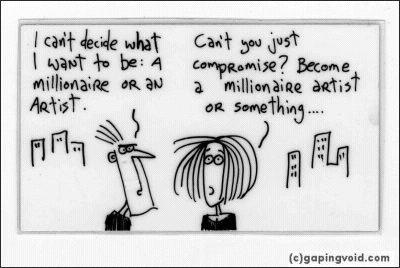
You gotta love Hugh Macleod's
gapingvoid blog, which is full of cartoons he's drawn on the backs of business cards (like the one pictured above). Not only that, his blog’s full of creative inspiration, and not only THAT, he offers THE BEST article ON creative inspiration.

In it, he provides 31 personal tips that have helped him over the years, which are listed below. He also wrote simple, compelling examples for each tip. Just exceptional.
Read it. Go here.

1. Ignore everybody.

2. The idea doesn't have to be big. It just has to change the world.

3. Put the hours in.

4. If your biz plan depends on you suddenly being "discovered" by some big shot, your plan will probably fail.

5. You are responsible for your own experience.

6. Everyone is born creative; everyone is given a box of crayons in kindergarten.

7. Keep your day job.

8. Companies that squelch creativity can no longer compete with companies that champion creativity.

9. Everybody has their own private Mount Everest they were put on this earth to climb.

10. The more talented somebody is, the less they need the props.

11. Don't try to stand out from the crowd; avoid crowds altogether.

12. If you accept the pain, it cannot hurt you.

13. Never compare your inside with somebody else's outside.

14. Dying young is overrated.

15. The most important thing a creative person can learn professionally is where to draw the red line that separates what you are willing to do, and what you are not.

16. The world is changing.

17. Merit can be bought. Passion can't.

18. Avoid the Watercooler Gang.

19. Sing in your own voice.

20. The choice of media is irrelevant.

21. Selling out is harder than it looks.

22. Nobody cares. Do it for yourself.

23. Worrying about "Commercial vs. Artistic" is a complete waste of time.

24. Don’t worry about finding inspiration. It comes eventually.

25. You have to find your own schtick.

26. Write from the heart.

27. The best way to get approval is not to need it.

28. Power is never given. Power is taken.

29. Whatever choice you make, The Devil gets his due eventually.

30. The hardest part of being creative is getting used to it.

31. Remain frugal.

Kubrick Analysis & Tribute


Monday, April 23, 2007

Subtext - Annie Hall


The clip above is a compilation of great moments from the film. (My favorite scenes are the ones with Diane Keaton singing in the nightclub. They slice through the heart and leave you bleeding.)

I share this because Edward Copeland recently posted
a wonderful article celebrating the 30th anniversary of Woody Allen’s Annie Hall.

Copeland said:


As Roger Ebert once wrote about Citizen Kane, that film's structure is such that no matter how often you've seen it, if you come in after it's started, you are never quite certain what scene comes next. Annie Hall works much the same way. While Annie Hall above all else is a comedy (and one of the rare times the Academy saw fit to honor a comedy), Alvy Singer does, if you look hard enough, share some superficial similarities to Charles Foster Kane. Both men are described as islands unto themselves and both just want to be loved, though Woody Allen got to speak frankly about sex in a way Orson Welles couldn't be allowed. ("Don't knock masturbation — it's sex with someone I love"; "As Balzac said, 'There goes another novel.'"; "That's the most fun I've had without laughing." Alvy also has his sexual prowess described as a "Kafkaesque experience," which the woman played by Shelley Duvall insists is a compliment.)

And all that reminded me of our good friend, Billy Mernit, because he had made a similar comparison as Ebert by calling Annie Hall “the Citizen Kane of modern rom-coms.” Not only that, I watched Annie Hall again last week. It's impossible to NOT love Diane Keaton. And every time I watch that movie, I always laugh at something different. Last week, I coudn't stop laughing about that spider in her apartment. And ya know, I could not watch the scenes of her singing in the nightclub without thinking of Mernit’s memorable
Clouds in My Coffee article about the time he spent a year and a half being Keaton’s vocal coach for an album that, regrettably, never came into fruition.

Of Keaton, Mernit wrote:


It’s hard to imagine anyone not getting along well with Keaton, on account of she’s adorable, period: smart, funny, sexy and above all, refreshingly accessible. With her there's no pretense, not a whiff of “I’m Important.” And in that period, coming off of Annie (and Goodbar and The Godfather), she was luminous with the glow of someone good-becoming-great, of coming into her own and being able to do things she’d always wanted to do. Like, sing some of her favorite songs, if she felt like it. You could feel it was a happy time for her -- there was that Warren guy in the picture, too -- and her giddiness was infectious.

In any case, as many of you know, we did a very popular study on
subtext in dialogue, and it occurred to me that Annie Hall contains the mother of all subtext scenes, and I really didn’t do that film any justice by only briefly mentioning it as an example.

And so I offer you the Annie Hall subtext scene, which occurred on Annie’s balcony on her first date with Alvy, just as it was written in the
script by Woody Allen & Marshall Brickman.

Hope you enjoy it.

-MM

-----------------------------------------------

They put their glasses together in a toast.

ALVY
God bless.

ANNIE
(Laughing)
Well, uh...
(Pausing)
You're what Grammy Hall would call a
real Jew.

ALVY
(Clearing his throat)
Oh, thank you.

ANNIE
(Smiling)
Yeah, well... you- She hates Jews.
She thinks that they just make money,
but let me tell yuh, I mean, she's
the one yeah, is she ever. I'm tellin'
yuh.

ALVY
(pointing toward the
apartment after a
short pause)
So, did you do shoot the photographs
in there or what?

ANNIE
(Nodding, her hand on
her hip)
Yeah, yeah, I sorta dabble around,
you know.

Annie's thoughts pop on the screen as she talks: I dabble? Listen to me-what a jerk!

ALVY
They're... they're... they're
wonderful, you know. They have...
they have, uh... a... a quality.

As do Alvy's: You are a great-looking girl.

ANNIE
Well, I-I-I would-I would like to
take a serious photography course
soon.

Again, Annie's thoughts pop on: He probably thinks I'm a yo-yo.

ALVY
Photography's interesting, 'cause,
you know, it's-it's a new art form,
and a, uh, a set of aesthetic criteria
have not emerged yet.

And Alvy's: I wonder what she looks like naked?

ANNIE
Aesthetic criteria? You mean, whether
it's, uh, good photo or not?

I'm not smart enough for him. Hang in there

ALVY
The-the medium enters in as a
condition of the art form itself.
That's-

I don't know what I'm saying-she senses I'm shallow

ANNIE
Well, well, I... to me-I... I mean,
it's-it's-it's all instinctive, you
know. I mean, I just try to uh, feel
it, you know? I try to get a sense
of it and not think about it so much.

God, I hope he doesn't turn out to be a shmuck like the others

ALVY
Still, still we- You need a set of
aesthetic guide lines to put it in
social perspective, I think.

Christ, I sound like FM radio. Relax.

They're quiet for a moment, holding wine glasses and sipping.

Sunday, April 22, 2007

Mystery Man in the News


Obituary: Mystery Man
Rumors of my demise have been greatly exaggerated.

mysteryman.org
I’m far better looking than this guy.

Devil worship links to Mystery Man
I sold my soul to master the craft.

Britney Spears Caught Making Out with Mystery Man
Um... I’m not proud of that.

Britney Spears & Mystery Man Caught Having Dry Sex At Rehab Center
It was just a harmless game of Twister. All the kids in rehab play it.

IOL: Mystery Man Anna's baby's father
Oh no - I demand a recount.

E! News - "Lost" finds new Mystery Man
I’m just trying to get close to Kate.

Mystery Man Declares War on Al Qaeda
Well, someone has to step up and get the job done.

Terror Watch: Bin Laden’s Mystery Man
I’ve got him right where I want him.

Statues a Mystery Man created
It was a phase.

Mystery Man Feat. The Last Emperor by DJ Jazzy Jeff on Rhapsody
Yo-yo-yo… Wassup, dogs? (They love to sing about me.)

Cameron Diaz and Jennifer Aniston share the same “Mystery Man”
If they’re okay with it, I’m okay with it.

Courteney's Date with Mystery Man
“Courteney Cox has been spotted holding hands with a Mystery Man, igniting further talk that her marriage with David Arquette is all but over.” We’re not dating. It’s just… her hands get cold.

Nicole Richie with creepy Mystery Man
Misprint - supposed to say “Mystery Man with creepy Nicole Richie.”

Mystery Man robs bank, flees into traffic
That was just... research.

Kylie Minoque seen with Mystery Man
She was using me so I’d write a script for her.
And I was okay with that.

Extra: Lohan's New Mystery Man - TV.com
Update - it's over now. She couldn’t keep up with all of my partying. Wimp. She’s also quite rude to the little people.

And finally -

ABC News: Mystery Man Plans Super Bowl Proposal
"He’s calling the proposal 'the most public declaration of love in the history of mankind.'" Will it be Jennifer? Cameron? Kylie? You'll just have to watch and see.

Hehehe

-MM

Thursday, April 19, 2007

Inner Conflict

This is a continuation of our series on Character Development Sheets.

If you were writing a tragedy, this would be the tragic flaw. In
Aristotle’s Poetics (which was his response to Plato's attack on Greek tragedy for encouraging a shameful indulgence in sorrowful emotion) this would be Hamartia – the mistake, the flaw, the failure, the fault, or the sin of the protagonist that would lead to his or her downfall. This is where we find in Sophocles' Oedipus the King and Shakespeare's Othello men who fall into pride, error, and in the end, self-destruction.

In non-tragic contemporary terms, this is the weakness of the hero, the internal obstacles of characters that keep them from achieving their
end goals. It is the adventurer with the deathly fear of snakes, the spy who can’t resist women he knows will ultimately betray him, the mobster who believes in "family values," or it’s the romantic with that one little hiccup that keeps him/her sidelined in the game of love. Or it’s what characters think they want and what they really need. It’s poor Willy Loman who wants to look at his life with a sense of pride and accomplishment, but he just cannot emotionally accept his failure as a breadwinner, his failure as a faithful husband, and his failure to bring up decent sons. And it is our job to not only define what the inner conflict is but also exploit that conflict in an external way, usually through relationships, in order to maximize its dramatic potential.

There was a great post by
Nienke Hinton last January over at the Writing Life on Inner Conflict. I loved this quote from Caro Clark:

“A character's inner conflict is not just being in two minds about something, not just being torn between obvious incompatibles (“I want to be a priest, and yet I love her”) but is about being in a new situation where old attitudes and habits war with and hinder the need for change. For instance, a man who drives himself to succeed because he doesn't want to be like his happy-go-lucky father is suddenly confronted with a situation where he isn't winning. Or an executive discovers that her ambition to be vice president of her company is being thwarted by her own self-doubt. This war inside each of your characters makes them act and react in complex ways.

“You show these internal conflicts not by means of internal dialogue (which is a cop-out and is dull), but by showing your characters responding to their own inner compulsions. She, for instance, decides to confront her own self-doubts by taking on a no-win project where the local people are opposing a development. She is determined to be hard-nosed, prove she's vice-president material. He is always confrontational, fearing that one minute of negotiation would be the first step to becoming a wimp like his father. You have a grade-A opposites-attract situation here, yet it is believable because we understand why each of them is acting the way they do, why they are foolishly stubborn, by it's important for each of them to win.”

And finally, I discovered a wonderful webpage,
Shy United, who posted a list of inner conflicts that might help inspire you:

1. One part of ourselves may feel we need to spend more time on our professional life while another part may believe we should spend more time with our family.

2. A part of ourselves may want to open up to a conscious love relationship, while another part fears being abandoned, hurt, suppressed, manipulated, or being unable to be ourselves in that relationship.

3. One part of ourselves may want to give those around us (children, spouses, friends) total freedom to pursue their happiness in their own ways, while another part fears losing control.

4. The part of ourselves that wants to please others may come into direct conflict with our desire to satisfy our own needs.

5. Part of ourselves may want others to support us, while the other feels restricted by their support or advice.

6. One part of ourselves may want spiritual growth, while another may feel the need for material security.

7. One part of ourselves may want to help loved ones or friends, but the other may feel that perhaps we are doing them harm by continuously bailing them out and not letting them solve their own problems.

8. One part of ourselves may feel a need to protect the planet by living a simple life with very little consumption of energy and products, while another part may want to enjoy all the comforts of an energy consuming, pollution producing lifestyle.

9. One part of ourselves may want to take a new job or leave a job that we have, while another part wants the opposite for different reasons.

10. One part of ourselves may believe in cooperating with others, while another finds that difficult.

11. One part of ourselves may have a desire for various objects or situations as a source of pleasure, while another part may feel, this is a sin, or that we are not spiritual if we partake of such pleasures. It may feel this type of pleasure seeking is a waste of time and energy considering our spiritual goals.

12. One part of ourselves may feel the need to have an exclusive relationship in which our happiness and security depend upon another person (usually a mate). Another part may find this an obstacle toward its need for independence, self-sufficiency, and freedom.

13. Our need for personal love may conflict with our need to develop universal love.

14. Our need to forgive may conflict with our need to hold on to negative feelings toward someone.

15. Our need to employ various disciplines may conflict with our need to feel free to do whatever we please whenever we choose.

16. Our need to follow our inner voice may conflict with our need to be like others and be accepted by them.

17. Our need to express our feelings as they are may conflict with our need not to hurt anyone.

18. Our need to express our real feelings and thoughts might clash with our need to have the others? acceptance.

19. Our need to follow a spiritual guide might conflict with our need to rebel against all types of advice or control.

20. Our need to control persons and situations in order to feel secure may conflict with our need to let things flow and allow others to act freely.

21. Our need never to show weakness may conflict with our need to share our weaknesses with others or seek their help.

22. Our desire not to ask anything from others may conflict with our need to have their help and support.

23. Our need for a stable routine for our balance and growth may conflict with our need for variety and change.

24. Our need to play our familiar emotional relationship games may conflict with our desire to get free ourselves from them.

25. One part of us wants to face and overcome our fears and blockages while another prefers to avoid and ignore them.

Your thoughts?

Wednesday, April 18, 2007

Screenwriting News! Links! Shout-Outs!


Hey guys,

I can't help myself. I just love this clip and added it to my
Goodbye, Lois article. It’s a love montage in honor of Richard Donner and includes a number of moments from Donner’s version of Superman II. In the last minute, you’ll see one of my favorite scenes from Donner’s version, which occurred toward the end of the movie. After it's all over, Superman drops Lois off on her balcony. A few words. She cries. He kisses her and flies away. Such a sweet little scene.

I noticed that a lot of people keep digging through my site looking for Mahler's Script-Beat Calculator. Thus, I added it to my sidebar under "Writer's Resources." Hope that helps.

Ya know, there’s so much going on that my head is spinning. Tomorrow, I’m going to continue my series on
Character Development Sheets. There’s another roundtable discussion in the works (similar to what we did with James Cameron’s A Crowded Room). I’ve also got a wide variety of script reviews coming (including Charlie Kaufman’s Synecdoche, New York), movie breakdowns, and I’m gearing up for a study on the fine art of WRITING EXPOSITION.

Not only that, on Friday (and for the next six weeks), I’m going to post hour-long videos on the birth of European Cinema. It’s a great series narrated by Kenneth Branagh, and if you have a passion for movies like I do, you will be absolutely addicted to these videos. Inspiring, moving, educational - it really changed my perception of film history.

Okay, I'm going to bed.

-MM

--------------------------------------------

New Scripts:

Identity

Black Dahlia

S.W.A.T.

Dead Silence

Ali

The Cincinnati Kid

--------------------------------------------

Around Scribosphere:

Billy Mernit on Kurt Vonnegut
Kurt looked more like a writer than any other writer I've ever seen. He was wearing a worn cardigan and corduroys, his hair was disheveled and mustache droopy, his eyes behind silver-framed spectacles seemed fixed on something miles away, and there was a cigarette hanging from his lower lip that looked glued there, defying gravity. If one can imagine New York City as a kind of giant industrial farm, then he looked like one over-worked farm animal. Slightly stooped, with his hands shoved deep in his cardigan pockets, he didn't so much walk as galumph, with a distracted and slightly pained expression, as if he'd recently been smacked in the face with a large wet salmon but expected as much: "so it goes."

John August on How to Introduce a Character
1. Show and tell - The best character introductions tend to include both a sense of what you see (the character’s physical appearance) and an intriguing tidbit about their personality and/or situation. That’s certainly the case with both Burke and Lance. You don’t have to give an age range, but it’s common. You don’t have to say the character is good-looking, but if it’s your hero, that’s not a bad idea. While many actors want to play “ordinary people,” they prefer playing “quirkily good-looking” ordinary people.

Scribosphere is going through a huge change and will hopefully take the scribosphere-revolution a big step further. It is aiming to become an advanced online workshop. They would love to get some feedback or tips about the concept. You can find more info by visiting scribosphere.

Unk on Using Google Notebook to outline your screenplay…
First of all, it only works with Firefox and Internet Explorer browsers so be aware of that… Second, it’s pretty damn fast to get started… Within MINUTES, I had the first act of an idea that’s been kicking around in my head more or less plotted out.

Great Site – Film Industry Terms by Department
Also added to my sidebar. Thank you, Dix!

Bill Martel on Script Notes
As a writer, I often know what works and what doesn’t just by instinct. That might be good enough when I’m writing the script, but it’s not god enough when I’m discussing the notes with a producer. There I need *evidence*. You can’t discuss feelings and instincts and opinions. We all have those. The only thing we can discuss as facts. That means we need to be able to figure out why one thing works and another doesn’t so that we can discuss the notes. We need to be able to cite evidence when we discuss notes, so that it’s not "he said, she said" but creative decisions based on a logical reason. And this goes for both sides of the table - producers and development executives need to be able to explain the reasons behind their notes.

I share this because everyone should feel free to blog about screenwriting
This is the first in a series of posts in which I profess to know something about screenwriting. One day, after a long and illustrious writing career, I might bump into these nuggets and chuckle at their caveman-like simplicity… Anyhoo. Less is more. Yeah, it’s a tired cliché, but that doesn't make it less apt. In the rewriting process, nothing has rung more true for me. Every draft I do, shrinks in page length, but grows in content. Amazing right? What it is, is the product of bloat coupled with the startling reality that more than one thing can be happening in a given scene. Yeah, I know, mind-blowing stuff. Take my football script that started out at 165 pages and is dangerously close to a respectable 120 as I write this.

--------------------------------------------

From GreenCine Daily:

Reverse Shot. On Demand
"If each film 'generation' has its own particular point of view, as surely, drastically, the next one will, then what is ours? And how does it aid/impede us?" ask Michael Koresky and Jeff Reichert in the editorial that opens Issue 19 of Reverse Shot: "On Demand." The "us" here are the RS writers themselves, and "most of us came of age as cinephiles in the era of home video... [W]e were the first generation which had access to a wide array of movies all of the time... And as a result, we watched, a lot, and over and over, making us the first on-demand generation." The issue, then, is a collection of pieces on films "seen many, many times, across different periods of [our] lives."

"
John Hughes movies don't lose anything on the small screen," writes Eric Hynes, who, "like thousands, perhaps millions of people roughly my age," has seen Ferris Bueller's Day Off "several dozen times." Back to his point: "Hughes's art depends on the quality of the writing, full stop. When his writing is good, as in Sixteen Candles, The Breakfast Club and Ferris Bueller's Day Off, his films are as funny, exhilarating, and remain as timeless as anything from the post-silent, pre-television heyday of Preston Sturges and Ernst Lubitsch."


Oxford American. Southern Movie Issue
Not only has the Oxford American put together an impressive "Southern Movie Issue 2007," they're also tossing in a free DVD for the first time - there's a trailer for it at the site, as well as liner notes by Marc Smirnoff - and they've posted a generous selection of articles online.

"
Baby Doll is a movie about people not having sex," writes Jack Pendarvis, for example. "Man, it is so hot when they don't have sex in that swing. But I'm getting ahead of myself."

Tom Carson looks back on the romance between Paul Newman, "a half-Jewish, middle-class joe from Cleveland," and the South. By the 70s, "From Cat on a Hot Tin Roof, Sweet Bird of Youth, and Hud to Cool Hand Luke, those blue eyes had spent so much screen time sizing up Delta mansions, muggy Gulf Coast hotels, and lonesome Texas ranch houses as fit thrones for the Newman loins that most actresses playing opposite him could have sued the scenery for alienation of affection. Putting on a Southern accent used to stimulate him the way chances to suffer did Montgomery Clift."

--------------------------------------------

Around the World:

Robert McKee Takes the Stand
Friends, this article is for the screenwriting history books. Robert McKee appeared as an “expert witness” in a Hollywood breach-of-contract case that pits Clive Cussler against Denver billionaire Philip Anschutz. Both sides are fighting over who is to blame for the financial failure of the movie "Sahara," which was financed by Anschutz's production company. And here is what McKee said: "I mean, I cannot overstate how terrible the writing is," McKee testified. "It is flawed in every way writing can be flawed." Attorney Bertram Fields said McKee's verbal attacks were "totally irrelevant" to the case. "He is a very good actor and he uses colorful language," Fields said. "I think he was all wet." "The writing is very bad," he testified. "How bad? I have thought of phrases like 'seriously flawed' [or] 'fatally flawed.' But it is beyond all of that, because when something is flawed there is an implication that something else about it is good." McKee said he counted more than 50 examples of coincidences, poor logic, out-of-character moments and improbabilities in Cussler's script. "On average, there is something unbelievable happening every two minutes," he said. The screenplay treated the audience like "dimwits that need everything explained to them three times over." By the way, McKee was paid by Anschutz at a rate of $500 an hour and has received more than $60,000 as one of Anschutz's experts.

Chinese debutante makes Orange Prize for Fiction shortlist
Guo, from a fishing village in southern China, has worked as a screenwriter, film director and film teacher as well as writing books in Chinese.

Incredible Hulk Screenwriter Discusses the Norton Signing
"It's not going to be a sequel, but it's hard to describe ... The best description I would say is something like 'Batman Begins' where it's not necessarily out of continuity with the other movies, though that was more of an origin story. It's much more of a reboot, the way that 'Aliens' is a sequel to 'Alien,' but the kinds of movie are different." Oh. Okay.

Stone Accused of Racial Slur
African-American screenwriter Barry Michael Cooper has revealed that Stone made an offensive comment when he approached the Platoon director at a party in 1991, to praise his work. The New Jack City writer tells the New York Daily News: "Oliver Stone's my hero, so I went over to him. (I said) 'Man, I love your movie 'Wall Street'. He said to me: 'Okay, thank you very much. I bet you like Scarface too. All n**gers like Scarface.'" But Cooper claims Stone is not racist, adding: "He was tipsy. We were all a little tipsy. I don't think he meant it maliciously."

`Sideways' approach to `Judgment in Paris'?
It will be interesting to see what screenwriter Robert Mark Kamen does with George Taber's 2005 book "Judgment of Paris" (Scribner; $26). Following the success of "Sideways," a story of two single guys on a Santa Barbara wine-country trip prior to one of them getting married, it's no wonder that a wine-related script about a historic event should receive more than the usual attention even before it's completed. For those who don't know about the famous Paris wine tasting in 1976, it was when top-rated California cabernet sauvignons and chardonnays were judged by French experts against some of the best French equivalents - red Bordeaux and white Burgundies. And in both categories, a Californian won.

Mark Poirier Penning Russian Bride Project
Pictures has hired screenwriter Mark Poirier to pen the untitled Russian bride project set up at Todd Phillips' eponymous production company...

Local Screenwriter Works On New Film
From Cedar City Review, UT - Strasmann is a screenwriter who got his start in college writing for a campus newspaper. Journalism was not necessarily his forte...

Open Letter To The Public Issued By KST Communications Over Copyright Infringement Issue
April 17, 2007 --- This press release is issued as an open letter to the public in an attempt to elicit others who have experienced copyright infringement in the entertainment-screenwriting industry to join against this issue - it is not designed or intended to publicly humiliate anyone. All of the following parties mentioned in this release were immediately contacted upon discovery of this copyright infringement issue, and each had several months and countless opportunities to resolve the situation. This press release is based on the facts to reveal the truth and further expose an ongoing problem within the entertainment industry.

Local screenwriter releases ‘Vacancy’
“Vacancy” is Smith’s first major studio release, although he has sold many films, including one called “The Last Kiss” to Mel Gibson. “Less than 10 percent of scripts sold are made. This is first one [of mine] to go to studio,” Smith said.

Director Todd Robinson has turned his grandfather's famous '40s case into a big time movie
Robinson, whose screenwriting credits include the 1996 true-life sea drama "White Squall," admits he took a few dramatic liberties re-creating Elmer's rocky relationships with his wife and son.

THE CROP REPORT - 4/14/07
…At this point, Carnahan could stroll into Alan Horn's office nude, brandishing a screenplay about hyper-intelligent tsetse flies trained by the CIA to travel back into time to assassinate the Zulu warlord Shaka (who himself has gone back in time to assassinate George Washington), and walk out with a seven figure deal. Matthew Michael Carnahan is living the screenwriting dream. But is he any good? Judging from State of Play (tentatively scheduled to begin principal photography in November)... yeah, he's real good.

Bruckheimer/Bay Teaming up for Prince of Persia Film
Jeffrey Nachmanoff, a screenwriter on The Big Gig and The Day After Tomorrow, is handling further revisions.

Why so many novels never make it to the big screen
Books provide filmmakers with ready-made plots on which to base screenplays (useful when plagiarism claims start to fly), and a proven audience. But unless they are global mega-sellers like Dan Brown, J K Rowling or Michael Crichton, the actual authors are lower on the food chain than the screenwriter, and if you think they are respected, watch Sunset Boulevard or The Player.

MOVIE MEN: Adam Brody plays a Michigan-bred screenwriter in Jonathan Kasdan's autobiographical 'In the Land of Women'
His friend is Jonathan Kasdan, who appeared briefly, at age 4, in a classic movie written and directed by his father, former Detroiter Lawrence Kasdan, titled "The Big Chill." In a 2002 episode of "Dawson's Creek," where he worked as a staff writer, he was cast in the small role of "Gawky-Looking Kid." He is now 26, making his directing debut with "In the Land of Women," which stars Brody and opens Friday.

Screenwriter AJ Carothers dead at 75
Film and television screenwriter A.J. Carothers has died of cancer at the age of 75 at his home in Los Angeles. Carothers, who had been in the writing business since the 1940s, was the writer behind the 1980s comedies "The Secret of My Success," starring Michael J. Fox, and "The Happiest Millionaire," starring Fred MacMurray, the Los Angeles Times reported Saturday.

Exclusive: Kurt Vonnegut's 'Sirens Of Titan' Being Adapted For Big Screen
Screenwriter James V. Hart reveals details of script, which late novelist collaborated on.

Mamet Gets His Black Belt
The man who taught you to Always Be Closing is just locking up a deal to direct a script he has written about the Jiu-Jitsu fight world of Los Angeles. Playwright, screenwriter and, now director, David Mamet has signed onto Sony Pictures Classic to direct Redbelt, says Variety.

Myst writer developing Splinter Cell 5 story
Mary DeMarle is helping shape the script for Ubisoft's new Splinter Cell game. In an interview printed in new book Game Design by Deborah Todd, DeMarle has recounted the exact design process behind the latest game, explaining that the writer and development team are working very closely, with the design and screenwriting disciplines helping inform one another.

‘Phoenix’ battles rumors
The screenwriter for the next Harry Potter movie is out to refute insults on the Internet. Claims swirling around late last week suggested that “Harry Potter and the Order of the Phoenix” suffers from too many plot cuts and that J.K. Rowling is asking for a scriptwriting team for the last two films. Michael Goldenberg, who did the book-to-film translation, says she has never relayed that concern to him.

--------------------------------------------

CyberScreenwriter:

Chinese Film Industry Is Estimated to Reach $900 Million
“China film industry is forecasted to grow from generating $250 million in box office profits in 2005 to reach close to $900 million by 2010 and almost $2 billion by 2015. Furthermore, China will follow a steep upward trend to overtake the U.S. film industry, currently the dominant global market leader, by sometime in 2050.”

--------------------------------------------

Slash-Film:

Sahara Movie Budget Includes $237,386 in Bribes

David Arquette plans Braveheart-like Epic

Raiders and Empire Screenwriter Lawrence Kasdan Remakes Clash of the Titans

David Goyer talks Super Max

David Goyer’s Unconventional Green Arrow Movie - Super Max

Kevin Smith’s Red State

--------------------------------------------

MovieBytes:

Ohio Independent Screenplay Award Winners Announced

A/Exposure Announces February Script of the Month

Gimme Credit Announces Cycle IV Super Short Screenplay Results
HollywoodIQ: Talent Manager Jeanne Field, Part One

VFF Announces Contest Results

TVWriter.com Announces Spec Scriptacular Finalists

TV Writer.Com Announces People's Pilot Finalists

Red Inkworks Announces Contest Winners

12th Annual Monterey Screenplay Competition Opens for Entries

Who's Buying What Interview: Matthew Cooke Delivering a Good Screenplay

Arizona Screenplay Challenge Announces Contest Winners

Creative Screenwriting Announces AAA Finalists

IndieProducer.com Announces Finalists

Screenplay Festival Announces 2006 Contest Winners

Hollywood Comes to Santa Fe Next Month

TVWriter.com Announces Spec Scriptacular Semifinalists

--------------------------------------------

Hollywood Reporter:

Kasdan's mighty pen on 'Titans'
Screenwriting hero Lawrence Kasdan, left, has been tapped to pen "Clash of the Titans" for Warner Bros. Pictures. Basil Iwanyk is producing via Thunder Road.

Marshall helming 'Nine' film adaptation
Rob Marshall will direct a big-screen version of the 1982 Broadway musical "Nine" for the Weinstein Co. Marshall and John DeLuca will choreograph the adaptation of the show, which won five Tonys, including best musical.- The Hollywood Reporter - By Gregg Goldstein

--------------------------------------------

Variety:

Fox 2000 is with 'Child'
Ridley Scott to direct film '44'

Singapore festival rebuffs censors
'Sankara' sets tone of cinematic renewal

Toronto festival honors Hong Kong
'Isabella,' 'Dumplings' amongst films

Rogue, Creaseys are 'B.F.F.'
'Studio' writers sell romantic-comedy spec

'Undateable' finds a match
Angelo, Brown sell pitch

Poirier weds Warners project
Phillips Co. to produce Russian bride film

Chow drops out of 'Red Cliff'
Star exits Woo epic three days into shooting

Goodman exit snarls 'Pope Joan'
Project's principal photography postponed

James Lyons, 46, film editor
Worked with directors Haynes, Coppola

The Back Lot: The Imus inquisition
Discussions of shock jock carries ominous subtext

Independent films going online
Directors bypassing standard distribution

Red to direct, write '100 Feet'
Janssen attached to star with Cannavale

Grant making it 'Happen'
Dance film to be based in burlesque world

Norton to star in 'Hulk'
Marvel movie to be released in 2008

Polanski's 'Pompeii' takes shape
RAI acquires Italian rights to film

New Line picks up 'Latin Lover'
Comedy to be produced by Benderspink

Greenberg psyched for bio
Hendrickson to adapt Kassorla's story

Sony, Mamet put on 'Redbelt'
Film set in Jiu-Jitsu fight world

Dueling directors Milk a good story
Singer, Van Sant line up similar projects

Report: Violence still aimed at kids
FTC urges changes to marketing standards

New rules for gay roles
Homosexual role models make mark in film

Risk-takers who should be honored
Gay actors, characters step out

New cameras have actors reloading
High-def revolutionizes the craft of actors, director

'Barbarella' back in action
'Royale' writers to revive character

Fraser returns for 'Mummy 3'
Weisz leaving lucrative franchise

Chinese back lot grows to epic proportions
Strengths are in its moviemaking infrastructure

Iceland's landscape brings big names
Island Locations: Iceland

3-D driving digital business
Demand for new technology in high gear

Monday, April 16, 2007

Indiana Jones & the City of Gods


First, we’re going to see a teaser trailer this Thanksgiving.

And second - Shia’s
officially signed. (Thanks for all the e-mails.) Shia said, “I can tell you I'm sort of the sidekick character, obviously,” which may reveal the fact that Henry Jones Sr. will have a diminished role in the film. He also says Lucas still won’t tell him what the MacGuffin will be. “Lucas looks at you and says simply, ‘I can't tell you that,’” LaBeouf says. “Then when he thinks he is supposed to tell you something but isn't sure, he gets up and leaves the room, goes in to talk with Spielberg and comes back and says, ‘Nope. Sorry.’”

However, I want to talk about the rumored title - Indiana Jones & the City of Gods. (Fanboys at Aint It Cool News now claim that this was the title of Darabont's rejected script.) In any case, this rumor originated from
an article in Empire Magazine. How did they hear this? “An email from an anonymous source.” Very flimsy, indeed, but at the same time, similarly flimsy reporting, such as the rumor about Shia, has a funny way of being true.

So IF this is true, what could this potential title mean?

I give you 5 theories:

-------------------------------------------------------------------------------


Number V

Grecian or Roman mythology:

I lump these 3 cities together as they are different branches of the same mythological tree. They each have the nickname “City of Gods:”
Athens & Catania for its Grecian gods and Rome, of course, for its Roman gods. The number of possible artifacts is endless, but none of this is likely, because the movies have always been rooted in religious artifacts and not necessarily from the tales of Zeus and Cyclops.

-------------------------------------------------------------------------------


Number IV

An Egyptian Artifact:

In southern Egypt, there is a famous archeological site,
Abu Simbel (photos here). There you will find The Great Temple dedicated to Ramesses, as well as the gods Amun Ra, Ra Harakhti, and Ptah, and thus, Abu Simbel earned the nickname “City of Gods.” The ancient Egyptians were obsessed with divinity, death, the afterlife, and reincarnation. You’re also looking at the possibility of seeing the ruins at Abydos, Karnak, Luxor, and also the island of Philae, which has the last hieroglyphics and a little known shrine to Egypt's lost gods.

Here, too, the variety of gods and artifacts is endless. The symbol next to the above paragraph is called the “
The Ankh” and was the Egyptian hieroglyphic character that stood for “life.” The Ankh appears frequently in Egyptian tomb paintings and other art. It often appears at the fingertips of a god or goddess in images “that represent the deities of the afterlife conferring the gift of life on the dead person's mummy.” The Ankh was often carried by Egyptians as an amulet, either alone, or in connection with two other hieroglyphs that mean “strength” and “health.” Mirrors were often made in the shape of an Ankh.

-------------------------------------------------------------------------------


Number III

An Incan Artifact:

Of course, the photo at the tip-top of this article is the very famous
Machu Picchu, an ancient South American Shangri-La for the Inca Emperor and nobility, but the site also has a number of temples that were dedicated to Incan deities. Who were the Incan deities? Endless. An artifact related to the Chakana is a possibility. In Incan mythology, Uku Pacha ("the lower world") was the underworld located beneath the Earth's surface. Its symbol was the snake, which was thought to die when digging into the earth and reborn after coming out of it. (Yeah, baby, a snake!) On the flipside, Hanan Pacha (“higher world”) was the Heavenly underworld. Only righteous people could enter it (much like Heaven), crossing a bridge made of hair. Other locations might include the city of Pisac, which like all Inca cities was designed in the shape of a sacred animal or the city of Cajamarca, where the Inca leader Atahualpa was murdered by Spaniards.

-------------------------------------------------------------------------------


Number II

A Buddhist Artifact:

“City of Gods” would, in fact, invalidate any theories about Islamic artifacts, including my own about
The Black Stone, because Islam believes in only one God. But with Buddhism...

We could be looking at a trip to
Tibet, the Potala Palace (pictured above), and the holy mountain of Kailash (all of which may explain why they are negotiating with Gong Li for a role). It is said of Kailash, “Sometimes, at sunset when the air is especially clear, it is possible to see the light surrounding Kailash. This light, starting within the depths of the mountain is the light of the City of the Gods, a forgotten Shambhala. Gods strictly protect their last shelter and the heritage of the great forgotten civilizations. Even today, no mortal can approach Kailash.” Another city we might see is Devinuwara. In Sinhalese language, “Devi” literally means “gods” and “nuwara” means “city.” “Buddhist as well as other community people visit this place at least once a year, during the annual festival season which occurs in June, to receive the blessings of the gods.”

-------------------------------------------------------------------------------


Number I

Indy’s Going to Mexico:

No city in the world is more famously known as the “City of Gods” than
Teotihuacán. It’s a huge complex full of ancient pyramids with very cool names like The Feathered Serpent Pyramid, The Cuidadela, The Pyramid of the Sun, The Pyramid of the Moon, and of course, the Avenue of the Dead. I love it!

The origins of this city are cloaked in mystery. Time Magazine had a great article about it called
The City of Gods. Here's Wikipedia: “For many years, archaeologists believed it was built by the Toltec people, an early Mexican civilization. This belief was based on Aztec writings which attributed the site to the Toltecs. However, the Nahuatl word "Toltec" means "great craftsman" and may not always refer to the Toltec civilization. Also, Teotihuacán predates the Toltec civilization, ruling them out as the city's founders. Other scholars have put forth the Totonac people as the founders of Teotihuacán, and the debate continues to this day. There is evidence that at least some of the people living in Teotihuacán came from areas influenced by the Teotihuacáno civilization, including the Zapotec, Mixtec and Maya peoples. The culture and architecture of Teotihuacán was influenced by the Olmec people, who are considered to be the "mother civilization" of Mesoamerica. The earliest buildings at Teotihuacán date to about 200 BCE, and the largest pyramid, the Pyramid of the Sun, was completed by 100 CE.” The city produced a great number of obsidian artifacts.

On a side note, Indy could also be searching for a Mayan artifact. The Maya believed they owed a blood debt to the Gods – one that could only be repaid through sacrifice. Deep in the rainforest of Guatemala, you’ll find the massive Mayan city of
Tikal, which has some sensational temples especially Tikal Temple I and II. In Mexico, you can find the spectacular temples of Palenque and Chichen Itza.

Sunday, April 15, 2007

"2001" Analysis


And don't miss Adam Dobson's great 2001 analysis over at Metaphilm:

"To torture a cliché, 2001: A Space Odyssey is an exploration of the Human Condition—or, more appropriately, as I intend to argue, the Human Predisposition. It is, at its simplest, a road-trip movie. But there is no intended destination or conceivable measure of success: like gap-year students parading aimlessly around South-East Asia, everything is concerned with the journey itself. Kubrick’s characters are in pursuit of themselves—their own purpose and meaning, as individuals and as part of the collective. Bound up with all this is the concept of wisdom—perhaps even Enlightenment."

----------------------------

Other Essays (thanks to The Kubrick Site):


2001 and the Motif of The Voyage by Claudia Zimny


Margaret Stackhouse's Reflections on 2001

2001: A Progressive Analysis by Sandra Venturini

2001: A Cold Descent by Mark Crispin Miller

2001: A critical analysis of the film score by Dariusz Roberte

2001 and the Philosophy of Nietzsche by Don MacGregor

Some Thoughts on 2001 by Roderick Munday

Design & Meaning in 2001 by Mark Martel

Extracts from "Moonwatcher's Memoir" by Arthur C Clark & Dan Ricter

Comparing 2001 and '2010' by John Morgan

The Case for Hal's Sanity by Clay Waldrop

2001: Random Insights by Barry Krusch

2001's "Hotel Sequence" by Derek Rose

Friday, April 13, 2007

5 Things You Don't Know About Mystery Man


(The pic above may or may not be the exterior of Mystery Mansion.)

I have been tagged by our very good friend, the
Unknown Screenwriter. If I understand correctly, I’m expected to list 5 things people don’t know about me. Hey, no problem!

1) The most famous person I ever met was Princess Diana. It was after her separation from Charles. She totally wanted me, too. Hehehe... At least, I love to think she did.

2) The last time I participated in a No-Limit Texas Hold ‘Em Poker Tournament, I made it to the final table and placed 7th overall. Screenwriting’s like poker. You shouldn’t play a bad hand just because everyone else is winning. Stay calm, stay confident, and strike when the opportunity is right. You gotta know when to hold 'em, when to fold 'em, and when to go ALL-IN, BABY! Hehehe...

3) Never told anyone this - I used to work in a complaint department, which was THE BEST training for Hollywood. I highly recommend it. Nobody, and I mean NOBODY, bitches like people in Hollywood. Or argue. It's insane. In any case, the complaint department gave me an eye for con artists, thick skin to deal with absurd criticism, the ability to resolve problems, and the discipline to stay cool when things get heated. It changed my life, actually. I refuse to be like those people who always complain everywhere they go (and try to get something for free). Life’s too short. You lose more than you gain living that way. I still love to get hate mail, though. Hehehe… By the way, my old co-workers still call me “the hotty.”

4) I rarely fall asleep afterwards. Sometimes, I’ll follow-up with a full body massage.

5) There’s a hip little downtown coffee shop I love to visit. I’ll bring my laptop and just write and write. Nobody bothers me. It’s great. A lot of other writers go there, too, with their laptops. In the last few months, I’ve noticed people looking at TriggerStreet, John August's website, Unk’s blog, and once (only once) - MY BLOG. After some time passed and it wouldn’t seem obvious, I said “hello” to the guy who had been reading my blog. He had no clue. Hehehe

(The pic below may or may not be the interior of Mystery Mansion.)

Thursday, April 12, 2007

Robert Bresson's "Pickpocket"


In the clips above, Paul Schrader, (whose Taxi Driver screenplay was recently and brilliantly analyzed by Miriam Paschal) gives us a very concise and excellent breakdown of Robert Bresson’s 1959 classic - Pickpocket. Very loosely based on Dostoevsky’s Crime and Punishment, Pickpocket tells the story of a young, directionless man, Michel (Martin LaSalle), who briefly finds a sense of quiet solace and accomplishment leading a life of petty crime. Michel becomes hunted and continually tracked, questioned, and challenged by the father figure/police detective in charge of his case (Jean Pélégri).

I share these clips because Schrader’s analysis would make any screenwriter uneasy. Bresson, like
Robert Altman, built a career on defying every single cinematic and storytelling convention. And some believe he struck gold with Pickpocket.

What are we, as screenwriters, to think of men like Bresson and Altman? Should they be adored or condemned?

In short, I have five thoughts: A) only Bresson can be Bresson, B) you have to master the rules first before deciding if and when you should break them (Bergman, Fellini, Godard, Altman all spent YEARS working mainstream and mastering stories in the classical form before they ventured into other territories like antiplots), C) you better have a damn good reason for breaking a rule, D) this type of storytelling can only be told outside the studio system, and E) Bresson, Altman, like so many other great filmmakers are worthy of being studied on our own. We shouldn’t rely on screenwriting gurus alone to learn about the fine art of cinematic storytelling.

Coincidentally, in the latest issue of
Offscreen magazine, there’s a new article in which Donato Totaro compares Bresson’s Pickpocket to Sergio Leone’s Once Upon a Time in the West, oddly enough. I loved what Donato wrote about the transitions, hallways, and doors:

“…the film’s extensive use of pathways, portals and transitional spaces (staircases, corridors, doors, train platforms, elevators) are suggestive of the several life choices ahead for Michel, who appears indecisive in making them. Throughout the film we see Michel enter and exit numerous doors and, more tellingly, leave doors unlocked, ajar, or open. Not only do the doors and corridors symbolize Michel’s possible pathways in life, but his perplexing (and unrealistic) habit of leaving his apartment door ajar when he leaves for the day can only be made sense of in a metaphorical manner: a symbolic (or unconscious) fear of closing off possible life choices.”

Strictly Film School wrote:

“Similar to A Man Escaped,
Bresson uses the recurring imagery of hands in Pickpocket exercising his fingers for dexterity, practicing scenarios for deception, executing the theft. However, in contrast to Fontaine's hands which serve as an instrument of his intellect, Michel's hands represent a moral fracture within his soul. In essence, his compulsion is a subconscious disconnection of his mind from his body, a separation between his ambitious, theoretical ideas, and his common, unremarkable existence. His attraction to a life of crime is a reflection of his psychological fear of failure - his inability to achieve his perceived potential - a suppressed realization that he is not the "extraordinary man" that he believes himself to be. In the end, we see a humbled Michel, enheartened by a long-awaited visit from Jeanne. As Jeanne kisses his hands, Michel is redeemed from his past transgressions, with a renewed faith and the love of a devoted woman.”

Girish on
Robert Bresson

“What I probably love best about Bresson is that for me, his films are projective surfaces. We don’t want a film to give us, all tied up with ribbons and bows, pre-digested and completely determined, an experience that does not include us or ask anything of us. An artwork should provide a place for the viewer to project herself into it, constructing meaning in a process of collaboration with the artist. (E.H. Gombrich in Art and Illusion calls this the “beholder’s share” of the aesthetic experience.) Bresson creates this projective surface, for one, by means of an aesthetic of withholding. He creates absences which draw us into the work; we find ourselves filling these absences for ourselves by projection.”

From
Cineaste:

“For many, a Bresson film is a punishing experience thanks to the alleged ‘severity' of his style and the bleakness of his narratives. I have heard viewers claim that while they were moved by some of his films, it was despite the style not because of it. Yet the frugality of that style—exactness of framing and editing, elimination of excess—has undeniably influenced a slew of contemporary European filmmakers, including Chantal Akerman, Olivier Assayas, Laurent Cantet, Claire Denis, Bruno Dumont, Eugene Green, Michael Haneke, Benoit Jacquot, and Jean-Pierre and Luc Dardenne, whose most recent film, L'Enfant, is yet another variation of Bresson's Pickpocket, among others—although none of these reject actors and expressive performances. Still, the adjective ‘Bressonian,' no less than ‘Hitchcockian,' is misused and overused. In the end, both filmmakers are inimitable because their styles are inseparable from a stern moral vision. Hitchcock distilled it with humor, a substantial dash of entertainment, and, of course, stars. Bresson, as uncompromising as his filmic style, offered it straight up: no ice and no water on the side.”

-------------------------------

Links:

Films of Robert Bresson from Bright Lights Film Journal

Robert Bresson Page from Senses of Cinema

EuroScreenwriters’
Robert Bresson Film Archive

Wednesday, April 11, 2007

Screenwriting News! Links! Shout-Outs!


A few trailers from Palm Pictures.

---------------------------------------

New Scripts:


Edward Scissorhands

The Faculty

---------------------------------------

Around Scribosphere:


One final blog-a-thon entry from Janet, the Manhattan playwright
“The heavens opened,” he was saying later, “And angels were singing,” and he handed me the screenplay, complete with directors’ notes and critique from the producers. I couldn’t believe his luck… no: I couldn’t believe mine. I studied that screenplay with more ferocity than my college application, and concluded that (having just re-re-re-read the book recently), the screenplay was the best adaptation from novel to cinema I had ever read.

Unk’s starting something new
“I’m considering sticking up another blog/site that would contain ONLY screenwriting articles… How-to info, tips, tricks, whatever. Totally about screenwriting and NOT anything personal. A total resource site that I would love to see be one of the ultimate resources about screenwriting.”

MaryAn’s Don’t Step on the Ducks
“We writers find great comfort in fingering the subjectivity of readers as the orange cones blocking the threshold of our careers. But a lot of us actually do suck. And, my guess is that most of us aren't half the writers we think we are. Yes, there's a mirror hanging nearby and ouch, the pain from even typing those words shoots straight into my soul. But, subjectivity doesn't negate or invalidate a conclusion. It only means the conclusion had to be based on something and that something was subjectivity.”

If you don’t believe me, take it from a pro reader
“We all know that scriptwriting only describes what can be seen on the screen yet our scripts are filled with description that is only for the reader’s benefit. Some of these are generally allowed or accepted (flowery character description, an explanatory aside etc) but really, scripts don’t need any of this at all as the reader will get everything they need to know from the simple action/image, sound, character and dialogue.”

Lianne’s Dates for Your Diary
“Here's my round-up of useful dates for script competitions and initiatives, festival submissions and other opportunities for the second quarter of 2007.” Great job, Lianne.

Christina Ferguson interviewed the Scriptapalooza Founder
“3. Over the years, is the overall quality of submissions in your screenwriting contest going up or down? ‘I'd say up and maybe that has to do with us getting so many scripts into the competition. But we are seeing really amazing writing coming from all over the world.’”

Because I love Maggie
“We were talking about how easy it is to extrapolate an event into a whole logical stream of events, which, face it, is an occupational hazard of writers--it has to be. You give us event V and we are figuring out the sequence to follow it all the way down the line to the implosion of the solar system. That is not so smart.”

---------------------------------------

CyberScreenwriter:


Film Producer, Michael Meltzer Continues Search For Screenplay for Next Horror Film
“Scripts are rolling in, but Michael Meltzer and Zoobody.com are not finished searching for the next feature horror film. If you have the script, here is the opportunity to have your movie made, but the search ends on Friday the 13th, April 2007. By logging onto and signing up for zoobody.com people can submit their script for this contest utilizing the revolutionary website.”

---------------------------------------

Around the World News:

No Two-Face Against "The Dark Knight"?
“Official screenwriting duties now belong to the director
Christopher Nolan and his brother Jonathan -- who recently collaborated on "The Prestige," and rather well if you ask me.”

Michael Goldenberg on working on 'OotP'
“Michael Goldenber, the screenwriter of the Harry Potter and the Order of the Phoenix movie recently gave an interview in which he discusses meeting JKR, adapting the book to film…”

'Payback' time for director
“AT first glance, "Payback," a 1999 Mel Gibson neo-noir that no one has ever mistaken for a classic, hardly seems an obvious candidate for a director's-cut special edition. But the new version, painstakingly reedited by writer-director Brian Helgeland and out this week on DVD, serves a useful comparative purpose. Seen side by side, the two "Payback" films are a case study in how ham-fisted studio interference can turn a not very good movie into a truly terrible one.”

Tina Fey Talks About Being a Working Mom
“1) Try to get pregnant, 2) Try her hand at screenwriting with her first feature film, Mean Girls, or 3) Get her pilot for 30 Rock green lit.”

Would-be screenwriters can find lots of help
"Every year, there's a handful of screenplays that clearly show talent," says Froehlich, a former Post-Dispatch arts and entertainment editor. "They may not be ready to shoot, and they may not be commercial. Sometimes, you can have a really good piece, and it just doesn't seem as if it's going to have legs, simply because people don't think they can make money with it. That doesn't mean the story isn't good."

'Iwo Jima' writer to speak to BSU
Yamashita, who was nominated for an Oscar for Best Writing/Original Screenplay, will be speaking exclusively to Ball State University students from Los Angeles, Thurber said. "We have hundreds of students majoring in production, and all of them need to understand the art of storytelling," Nancy Carlson, chairwoman of the Department of Telecommunications, said. "We believe the power of the film is in the story, so we were searching for a screenwriter rather than a director so that we could better understand the story."

A screenwriter takes a turn behind the camera
"I was at a point where I wanted, I was craving a different creative experience," writer-director Scott Frank said. "I was so comfortable in my life that I started to see 10 years down the road that I was going to be bored. I was already a little bored with myself. I didn't want to get bored with my life." Considering he spent the last 10 years on the screenplay for "The Lookout," it seemed appropriate to make the transition into directing. "In this case, because I had so much time to think about it, I really understood the material," Frank said during a press junket last week. "So when the actors came in I could really talk to them about the material."

Film group seeks creative scripts
White River Indie Films wants your screenplay. The nonprofit educational organization is holding what is anticipated to be the first annual WRIF Screenwriting Contest.

Rachel Stein, Showgirl
Verhoeven has insisted that Black Book, which he and his screenwriter Gerard Soeteman began working on twenty years ago, is based on historical cases...

Hanks Still Up to Code?
“The studio paid Da Vinci screenwriter Akiva Goldsman a whopping sum to reprise scripting duties on Angels…”

Screenwriter Ron Sasso Will co-pen the Script V-QUAD
Apr 10, 2007 -- /prbuzz/ -- A deal was struck today between Momentum Ent. and Ron Sasso to co-pen the comedy "V-QUAD." The Lion’s Agency is a faith-based literary agency serving the film/television industry. As the industry’s first faith-based literary agency specializing in filmed entertainment, The Lion’s Agency is quickly becoming known within the entertainment industry. Writers can submit a query letter by visiting the website
http://www.lionsagency.com/

Green light for Green Arrow
“Based on an original idea by JUSTIN MARKS, who is set to pen the script, Super Max will be produced by Batman Begins screenwriter DAVID GOYER.”

David Goyer tapped for Green Arrow, DC villains flick
Wizard Universe discussed the Super Max project with director David Goyer, which will be based on a script he is developing with screenwriter Justin Marx.

An honest-to-goodness 'Hoax'
“Instead of taking an easy, sensationalist approach to the material, Hallström and screenwriter William Wheeler imbue it with thematic resonance…”

Bringing Up the Rear
“While screenwriter Chris Landon insists the spark for this week’s Shia LaBeouf thriller Disturbia was Martha Stewart’s house arrest…”

Local screenwriter buys St. Pete Beach theater
A Pass-a-Grille screenwriter behind Hollywood blockbusters including Fantastic Four, The Hulk, and The Punisher has purchased the Film Paradiso Beach

It's the Kasdan family business
The filmmaking brothers Jake and Jon take a cue from their dad, Lawrence.

---------------------------------------

MovieBytes:

TV Writer.Com Announces People's Pilot Finalists

Red Inkworks Announces Contest Winners

TVWriter.com Announces Spec Scriptacular Finalists

12th Annual Montery Screenplay Competition Opens for Entries

Who's Buying What Interview: Matthew Cooke Delivering a Good Screenplay

IndieProducer.com Announces Finalists

Screenplay Festival Announces 2006 Contest Winners

Arizona Screenplay Challenge Announces Contest Winners

Creative Screenwriting Announces AAA Finalists

TV Writer.Com Announces People's Pilot Semifinalists

Hollywood Comes to Santa Fe Next Month

TVWriter.com Announces Spec Scriptacular Semifinalists

FirstGlance Announces Contest Results

Call for Entries: Nevada Film Office Screenwriters Competition

Find the Funny Awards Kick Off May 6

---------------------------------------

Hollywood Reporter:

Sendler Holocaust picture set
Producers Jeff Rice and Jeff Most have teamed with screenwriter Lawrence Spagnola to bring the Irena Sendler story to the screen.

---------------------------------------

CS Daily:

Gromit Has a New Caretaker (Variety)
A few months after ending their partnership with DreamWorks, Wallace & Gromit and Chicken Run creators Aardman Animation sign a three-year, first-look deal with Sony.

Sandler Jumps Into Bed With Shankman (Variety)
Adam Sandler returns to comedy with Disney's Bedtime Stories, with Bringing Down the House's Adam Shankman directing.

Hamburg Finally Coming Along (Variety)
Along Came Polly's John Hamburg signs a first-look deal with DreamWorks, home of the Red Hour Films, the company co-run by frequent collaborator Ben Stiller.

Becker Finds His Missing Link (Variety)
Disney signs up Wild Hogs director Walt Becker to write and helm an adaptation of his own 1998 action novel Link.

Burton Gets Lots of Reading Done (Variety)
Speaking of comics, Warner Bros. hires Mark Burton (Madagascar, Chicken Run) to adapt James Turner's comicbook Rex Libris, which is about an everyday guy who becomes part of a secret sect of librarians who battle dark forces when chasing down overdue books. That last part wasn't a joke, I swear.

Morrison Remains in the Area (Variety)
Grant Morrison, a comic book writer responsible for such titles as Justice League of America and New X-Men, is hired by Paramount to write the screenplay for the videogame adaptation Area 51.

Paulsen is Disney's New Sitter (Variety)
Nancy Drew writer Tiffany Paulsen to write a remake of 1987's Adventures in Babysitting for Disney. The title? Further Adventures in Babysitting. I smell a winner.

Writers Try and Save the Holidays (Variety)
Fox Searchlight options Elisa Bell (Little Black Book) and Jeff Kline's holiday comedy spec The Rosenbergs Save Christmas.

An Early Christmas Present
As a special treat for viewers of Disney's annual presentation of A Nightmare Before Christmas in 3D, an early Tim Burton short, Vincent, has been restored and converted to 3D and will play in front of the film at all screenings.

File Under Weird and Useless
Because Americans aren't quite fat enough, Time Warner is now offering a service where your telephone caller ID will actually display itself on your television screen. Pretty soon, you won't have to move at all.

Mavericks Open Up
Quentin Tarantino and Robert Rodriguez talk about their love of filth and films in this interview with Coming Soon.

Easy Being Green (registration required)
The LA Times catches up with the team behind Shrek the Third to talk about the new wrinkles they're throwing the ogre's way and why their experience makes the process that much better.

Dead Mobsters Tell Tales (registration required)
The Museum of Television & Radio held a special event titled "The Dead Sopranos," in which the actors who have been killed off on the classic series got together to discuss the show and its unparalleled violence.

Victory! For HBO
The New York Observer hugs it out with a look at Entourage's third season. If you're a fan of the show, but don't care to know what's ahead for Vince and the gang, you may want to avert your eyes.

Is Hollywood Losing Its Faith? (Variety)
Variety offers up a a series of articles on faith-based entertainment and its role in the film industry.

Filmmaking Pair Ready to Live Free
Live Free or Die (not to be confused with the latest adventures of super-cop John McClane) writer-directors Gregg Kavet and Andy Robin talk about their independent comedy and how they choose to define success as independent filmmakers.

Animators Encouraged to Wear Two Hats
Not that the lines weren't blurred already, but Disney animation has become increasingly encouraging of their filmmakers and videogame developers to work in tandem, coming up with the best games possible based on their films.

What's Up, Docs?
You'd be doing yourself a favor by paying a visit to Four Docs, a Peabody Award-winning site that shows viewer-made documentaries on any and all subjects.

The Best of the Worst
In honor of the expensive one being released this weekend, IGN has collected their favorite 10 grindhouse pics for your enjoyment.

Prepare to be Carved
Many Grindhouse reviews point out that Eli Roth's faux-trailer, Thanksgiving, may be the highlight of the entire film. Now you can see it for yourself and judge.

It's Parents Couldn't Be Prouder
Be sure to check out this trailer for New Line's upcoming film Martian Child and put it on your summer watch list.

---------------------------------------

Variety:

Ray takes post at Sidney Kimmel
Former UA honcho heads up distribution unit

Universal sees the 'Whole' picture
Helms will star in, co-write 'New Hugh'

Phillips to produce 'Chadster'
Samonek is aboard to write the script

Cannes archives available online
Festival launches footage site

DiCaprio to star in 'Body of Lies'
Scott will direct the project for WB

Wenders set to drive 'Road'
Meredith to write, direct father-son dramedy

Ford leads immigration drama cast
Liotta, Penn also board "Crossing Over"

Anonymous acquires 'Acquisitions'
Poirer to adapt Vachon book

Bob Clark, 67, director
'Christmas' filmmaker's son also killed in crash

Goodman sued after refusing 'Joan'
Constantin Film files suit against actor

Burt Topper, 78, filmmaker
Director also wrote and produce Hollywood hits

DreamWorks pacts with Hamburg
Deal is for writing, directing and producing

Comicbook author to write 'Area 51'
Paramount taps Morrison to work on film

The gospel according to research
Hollywood courting faith community

Script contest taking submissions
Grand prize winner will receive $10,000

Saturday, April 07, 2007

Indiana Jones 4


Hey guys,

I'm going to publish a new Indy IV article soon, and I've also been meaning to revise, reorganize, and update my old Indy IV post, which is below. It's the accumulation of all my notes regarding the widespread rumors and babbling gossip (always from the wagging tongues of fanboys) about the fourth installment of Indiana Jones. I followed these rumors closely because I, like everyone else, dreamed of a shot at writing the new script. I think it would be fair to say that this is one of the most exhaustive, comprehensive reports on all things Indy IV available anywhere on the web.

This update includes the 1999 "red scare" rumor, details about M. Night Shyamalan's involvement, script reviews, and at the bottom, you'll find a list of links. Hope you enjoy it.

-MM

-------------------------------

1994:

Harrison Ford revealed at the Venice Film Festival that he was considering playing his most famous character one last time. (It's been long acknowledged
and reported that Spielberg and Lucas were DONE with the Indiana Jones series, but Harrison Ford has been the one pushing for the fourth film.) A couple of months later, that “bastion of investigative journalism,” the Daily Mail, ran a story (titled "From Speed to Ford Escort") claiming that Sandra Bullock would play Indy's "sparky" sidekick in Indiana Jones And The Lost Continent, which allegedly concerned the fate of Atlantis, a rumor that Variety put to rest. "While Nazis and various cultists couldn't stop Indy, the lack of a suitable script has pushed back the fourth installment in the series for the time being," the article said.

1995:

By Oct, we knew that Jeffrey Boam was working on scripts for Indiana Jones IV and Lethal Weapon 4. In
an article in Variety, Boam was quoted as saying that Spielberg wanted the pic to be shot almost entirely in L.A. Only one week will be on location, probably in Honduras. Russia had first been planned. "And," added Boam, Harrison Ford will play his own age, "so he can limp and/or wear glasses!" Apparently, Boam had been asked to flesh out the MacGuffin that Steven and Harrison didn’t want to do. Empire reported that the story concerned an attempt to foil a Soviet plot to establish a missile base on the moon, or had something to do with the UFO crash at Roswell, New Mexico, or both. I can’t imagine why Ford and Spielberg wouldn’t want to do THAT. Poor Jeffrey.

1996:

In a Drew Babcock interview (which I can't find anymore - only referenced here), Spielberg assured the world that Atlantis had not been considered as part of the scripting process and mentioned that the script "had to do with Adam and Eve." After Babcock did some digging, a source at Paramount told him that the title Indiana Jones and the Garden of Life was being tossed around. In May ‘96, a script entitled
Indiana Jones And The Sons Of Darkness, which was credited to Boam, hit the web from someone who claimed to have lifted it from Lucasfilm's offices. As reported by Empire, “The script, which concerned a race by Indy to beat the Russians to the remnants of Noah's Ark, was removed from the web a day after its initial posting, fuelling rumors that it was genuine.” Fans were invited to post feedback because "Lucasfilm is monitoring the Web to assess what Indy fans do and don't want to see." In truth, the folks at Lucasfilm had nicknamed this script "Indiana Jones and the Sons of Plagiarism." Four months and several cease-and-desist notices later, ambitious Indy fan, Robert Smith, fessed up to having written a bogus script. Later, Kevin Costner and Tom Selleck were rumored to play Indy's 'bad seed' brother.

1997:

This is the year that brought us Chris Columbus’s
Indiana Jones and the Monkey King. At the time, Columbus was known for writing and directing Goonies. He would later go on to direct a couple of Harry Potter films. In any case, the story of Monkey King had Indy, Marcus Brody, English anthropologist Dr. Clare Clarke and 'Scraggy', a Portuguese guide, on the trail of a legendary Chinese artifact, which was believed to hold the secret of eternal life. We would learn later that this was in fact, a rejected Indy 3 script. (The absence of Henry Jones Sr. would’ve been your first clue, and sadly, the actor who played Marcus Brody had passed away in ’92). Of this story, Justin Clark (Ugo Screenwriter’s voice) wrote, “Where Columbus commits his most cardinal sins is with the characters. Long story short, they're cartoons. Indy is an asympathetic womanizer, with only fleeting hints of confidence, and constantly being made the fool by his situations. Screwing up Indy right off the bat should've been where Columbus put the pen (well, nowadays, keyboard) down, and handed over script duties to someone else, but sadly, it doesn't stop there. He also sees fit to saddle Indy with a virtual army of stereotypes (particularly, the stiff, British female scientist who guides him to a stray member of the lost city, and the superstitious African who drives him and his crew around while spouting words of wisdom from his many gods) and annoying sidekicks, none more so than Betsy, a clinging, pain-in-the-ass harpy who, somehow, we're supposed to think has chemistry with Indy. If you thought Willie Scott's perpetual screaming was a problem, she'll look like Katherine Hepburn by comparison. Some of the script's most cringe-worthy moments come from her. And the second I realized the characterizations weren't getting any better, that's when I realized this script, no matter what came later, wouldn't work. And believe me...it does get worse, especially once Sun Wu Kung shows up.”

Also in ’97, there was the rumor (from the now defunct Corona site) in which Lucas told a Dutch TV magazine that Indy will have a son. In May '97,
Spielberg told Variety that he, Lucas, and Ford are "tenacious" about a fourth "Indiana Jones." "We are totally committed to one -- if the story is right, of course." Speaking of tenacious, the rumor about his brother just would not die. Posted on the web was a note from an anonymous Paramount source who said that Indy would not only have a brother but he would also be cast by an unknown. In late '97, Corona got word about a minister and a theologian who were asked to do some historical accuracy checking on the Indy IV script. Apparently, the script dealt with the Garden of Eden and was very "religious in tone." Also in '97, Aint it Cool News spread the rumor about Indy being in his 50's searching for Noah's Ark and that Lawrence Kasdan was the writer. They also reported a rumor about a quest for Shangri-la, which was utterly baseless.

1998:

In January, Dark Horizons posted what it claimed to be the opening pages of another script, entitled
Raiders of the Fallen Empire, which sounds like a reference to the Roman Empire, but apparently it had to do with Indy's discovery of the Garden of Eden. No matter. It was a hoax. (According to Corona, this debacle stressed out a few Paramount execs. Rumor has it that Lucas was very interested in “Fallen Empire,” but it was an unsolicited spec script, and he had not yet decided whether to purchase it. Even though there is still very little known about this script, the mere leaking of the title is said to have been enough to send blood pressures rising.) Later, rumors flew from Corona that Mark Hamill was being considered to play a villain in the Indy sequel. Hamill's "people," however, assured Cinescape that the rumor had no basis in fact. In May, Mr. Showbiz spoke with Jeffrey Boam about his rumored Lost Continent script. He said that he hadn't heard of anything called that, and in fact, he was told not to place a name on the script he turned in two years prior and had not heard anything about it since. In November, Lucas told those at the Screen Producers' Association conference held in Australia that the Indy IV script had been completed. He cited the availability of Ford and Spielberg as the remaining obstacle. However, later interviews with Ford and Spielberg would indicate that all were not in agreement with this script. Then there was the "Law of One" rumor in which Cinescape was handed a script where the action took place in 1953 and involved a "race to harness the power of the ancient device which was responsible for the destruction of Atlantis." Uh huh. Willie Scott also appeared in this script. '98 also brought us a new legitimate script, Indiana Jones and the Saucer Men From Mars, which came out of the blue and was apparently written by The Fugitive scribe Jeb Stuart from a story by Stuart and Lucas. Saucer Men From Mars concerned an alien artifact that constantly changes hands between Indy, Russian baddies, and a group of extra-terrestrials. Indy gets married to beautiful linguist Dr. Elaine McGregor, but the ceremony gets interrupted by the arrival of Elaine's ex-husband, Bolander who takers her away to White Sands, New Mexico. There, a spacecraft has crash-landed, killing its alien occupants and sparking a race between the Americans and Soviets to discover the secrets of the alien ship's fuel supply, a stone cylinder covered in hieroglyphics. The wedding was great fun.

1999:

There was the rumor that Dennis Lawson, the guy who played Wedge Antilles in Star Wars, was set to portray Belloq's brother seeking revenge for the events of Raiders, which was flatly denied. And then there was the
Sword of Arthur script, which was a hoax. However, the pranksters cleverly peppered their pages with "Property of Lucasfilm Ltd," which made it almost feel real. The story had to do with the search for King Arthur's magical sword, Excalibur, which was reputedly hidden on Enigma Island, a small isle off the Spanish coast, six centuries earlier. The Nazis are after it, too, as are the surviving descendants of the original Knights of the Round Table. Indy and his companions - Including Anthony Brody (Marcus' son) and Arianna Smith (a kind of female Indy, as might be guessed from the name) - recover the sword, only to have it snatched from their grasp by the arm of a woman who reaches up from the Atlantic Ocean to reclaim it forever. (Indy loses an eye during one fight and has to wear an eye-patch the rest of the film.) The “aspiring writers,” Steven Frye and Michael Prentice, claimed to have been duped into parting with the script, unaware it would be touted as the real thing.

Lest we forget, 1999 also brought us Indiana Jones and the Red Scare, which hit the web on July 17. This 12-page treatment,
as reported by Empire, “allegedly seen by someone working at Industrial Light & Magic, was set in the early 1950s, as Indy is retained by Eisenhower's administration to find out about the Russians' retrieval of artifacts found in Hitler's bunker. No one has ever owned up to the treatment.”

2000:

There was the rumor that Natalie Portman, while on the set of Star Wars, asked Lucas if she could
play the role of Indy's daughter, Idaho. Spielberg told an Italian newspaper, “Actually, I have to answer that same question all the time: 'Dad, when are you going to film a new Indiana Jones movie?' But tonight I want to make a promise - Indiana Jones is coming back soon.” That was seven years ago. Then there was M. Night Shyamalan, who, fresh off his success from Sixth Sense, admitted on The Howard Stern Show that he'd met with Spielberg, was in early talks to do something with Indy, and that he would love to write the script. Shortly thereafter, Variety reported that Shyamalan was on board to write the new script and that filming would begin in 2002. But then we’re told scheduling didn’t work out. Uh huh. Harrison Ford described his departure as "the failure of George and Steven to attend to him." Lucas admitted he would not be able to give the project his full attention until he completed the new Star Wars trilogy… in 2005.

On a side note - Jeffrey Boam, one of the first reported Indy IV screenwriters would pass away this year due to heart disease, sadly. You just have to love Jeffrey Boam. He wrote some fun scripts – Innerspace, The Dead Zone, The Lost Boys, Funny Farm, Indiana Jones and the Last Crusade, and of course, Lethal Weapon 2 and 3. We’ll miss you, buddy.

2001:

What? No fake scripts this year? I’m disappointed.

2002:

In January, we’re told that they
already have a title. Spielberg said, “Kate is in it.” Ford is quoted as saying that they finally have “the right script.” But then, in February, Empire reported that they approached Stephen Gaghan to write a new screenplay, which didn’t work out. In April, Empire reported that they’re courting Tom Stoppard to write a new screenplay. A couple of days later, Lucas confessed, "There is a scene where a lot of Indy's ex-girlfriends show up, but they are not major characters." This had to have been a direct reference to Jeb Stuart’s script, an idea that apparently everyone still wants to use. In May, we’re given the news that Frank Darabont has taken the helm as the new screenwriter. In July, we learn that the story will be set in the 1950s, and there will be no Nazis. In December 2002, while promoting Catch Me if You Can, Spielberg said he planned to shoot two films before Indiana Jones 4 in 2004 for a release the year after. He also dismissed shooting it digitally.

2003:

Frank Marshall said that there will be
no son for Indiana Jones. He said, "We're sticking with Indy on his own. He still gets around pretty good." Really. In June '03, Variety told us that Frank Darabont whipped Indiana Jones 4 into shape for a 2004 start. Woo hoo! In August, Darabont said the words that brought such warmth to my heart: "I absolutely don't want to do things like having him say, 'I'm getting too old for this shit...' I don't want to be slipping and sliding in cliches. This character is no longer in the 1930s. He has to age honestly. He's got to be in the 1950s." Amen to that. In September, Ford told Variety: "Steven Spielberg and myself have reserved time in 2004 to begin shooting." (Some claim that Darabont’s title was Indiana Jones and the City of Gods.) Also in September, the question about the use of CGI came up, and Frank Marshall told Empire: “I think we're going to try and rely, like the first two movies, on realism and not try to do too many things with the computer... When you start getting into computers you get fantastical situations like in the Matrix or movies like that. We don't want that, we want exciting heroism, we want seat-of-your-pants, skin-of-your-teeth action. We didn't have all the money in the world on the first films and we want to keep that B-Movie feel. We want to make Indy 4 like we made the first three.”

And finally, a UK website for women called FemaleFirst
alleged that an insider on the production told them that Spielberg told Ford to "'get off of any and all exercise programs.' It's been 15 years since the last Indy movie and obviously Harrison has got a lot older but that's not a problem for this movie," the "insider" told FemaleFirst. "Steven doesn't want a middle-aged guy trying to look young — he wants to bring a new type of hero to the screen. He's going to be older and wiser and a lot less physical than Indy of old." Oh. Hmm.

2004:

In January, Darabont turned in his script. "I've finished my work,” he said, “now it's in the hands of God, or Spielberg and Lucas if you prefer.” But a month later, Lucas
rejected Darabont’s script despite the fact that Spielberg was so excited about this script that he told Darabont this was the “best draft of anything since Raiders of the Lost Ark.” Darabont said, “The project went down in flames. Steven and I looked like accident victims the day we got that call. I certainly don't blame Steven for it. He wasn't in a position to overrule George, and wouldn't have overruled him even if he could. He and George have been close friends for a long time, and they've had an agreement for years that no Indiana Jones film will ever get made unless they both completely agreed on the script. It was just such an awful surprise, after all my hopes and effort. I really felt I'd nailed it, and so did Steven.”

In October, we learn that Jeff Nathanson, writer of Catch Me If You Can, was
brought in to do the rewrite. Not only that, it was a PAGE ONE rewrite. Spielberg would later say in an interview that none of Darabont's script will be used. At all. Zip. All we will know about Nathanson’s script is that he moved it back to the '40s. Later that year, while shooting War of the Worlds, Spielberg met with stuntman Vic Armstrong to discuss three stunt sequences he had envisioned.

2005:

In January, Ford
gave a deadline and said that if they didn’t make this movie by 2008, forget about it. Later that month, Spielberg confirmed that Indiana Jones 4 will be his next film, calling it "the sweet dessert I give those who had to chow down on the bitter herbs that I've used in Munich.” He would later say he’s “taking a year off.” In May, Lucas is quoted in Time Magazine as saying that he didn’t plan to make anymore Indy films. In June, Ford made a joke at a press conference that the working title of Indy IV was Indiana Jones and the Opal of the Mer-Man Prince. The news spread like wildfire across the web, and a week later, Spielberg had to issue an official statement to kill the story. A few months later, there was the rumor about Spielberg visiting the set of Memoirs of a Geisha and telling Michelle Yeoh he still wants her for Indy IV. (Her agency reported in '98 that she met with him to discuss her role in Indy IV.) Close to the end of the year, we’re told that Nathanson’s script was "finished" and "approved."

2006:

Apparently, Nathanson’s script was NOT "finished" and "approved," because in February,
Entertainment Weekly reported that Spielberg himself was working on the script. May '06, Frank Marshall confirmed that there might be a desert. Oh. Nice. Then, on June 23, David Koepp was hired to polish the script. It would be “due” in a few months. He’s Spielberg’s trusted “closer.” Really. And then came Connery's official retirement despite Lucas' public assurance that he will push him into doing it. In an August ’06 interview in Empire Magazine, Lucas said, “We’re basically going to do The Phantom Menace. People’s expectations are way higher than you can deliver. You could just get killed for the whole thing… We would do it for fun and just take the hit with the critics and the fans.” (I don't know about you, but as a screenwriter, as a lifelong lover of movies and Spielberg and Lucas and Indiana Jones, that sends CHILLS up my spine.) The article went on to say that the “damned if you do, damned if you don’t” situation freed up an idea for a plot that was originally deemed too incendiary. “I discovered a McGuffin,” continued Lucas. “I told the guys about it and they were a little dubious, but it’s the best one we’ve ever found… Unfortunately, it was a little too ‘connected’ for the others. They were afraid of what the critics would think. They said, 'Can’t we do it with a different McGuffin? Can’t we do this?' and I said 'No.' So we pottered around with that for a couple of years. Then Harrison really wanted to do it and Steve said, 'Okay.' I said, 'We’ll have to go back to that original MacGuffin and take out the offending parts and still use that area of the supernatural do deal with it.'” Hmm. In Sep '06, Karen Allen may have reignited rumors that Indy will have a daughter. (That rumor has been recently squashed.) And then, of course, in December 29, 2006, Ford, Lucas, and Spielberg confirmed that they will be shooting the movie, which will be released May 22, 2008. Production will start on June 18, 2007. All we know is that it will be a “character piece” with “very interesting mysteries.”


Do you know what the picture above is? No, it's not the government warehouse where they stored the Ark of the Covenant. This is, in fact, where they store all of the Indy IV drafts. Hehehe...

-------------------------------
Links:

Official Indiana Jones site
Raider.net’s Indy 4 Page
SpielbergFilms.com’s Indy 4 Page
Slash Film’s Indy 4 News Page
Rotten Tomatoes’ Indy 4 News Page
ComingSoon.net’s Indy 4 Page
Raven’s Definitive Indy 4 Speculation Index

Screenplays:

Raiders of the Lost Ark (Third Draft, August 1979)
Indiana Jones and the Temple of Doom (Undated, unspecified)
Indiana Jones and the Last Crusade (Undated, unspecified)

Legitimate but rejected Scripts:

Chris Columbus’
Indiana Jones and the Monkey King
Jeb Stuart’s Indiana Jones and the Saucer Men from Mars (zip file)

Honest and Dishonest Fakes:


Fake Indiana Jones Scripts
Fan Fiction here and here.

The Wedding of Indiana Jones


In January, 2002, Spielberg told us, “Kate is in it.” A few months later in April, Lucas confessed, "There is a scene where a lot of Indy's ex-girlfriends show up, but they are not major characters." Even Ford said with a wink: "It's probably going to be the best scene in the movie." That was five years ago. However, we might have the faintest clue as to which scene they may be referring. This may have sprung from Jeb Stuart’s script, Indiana Jones and the Saucer Men from Mars. (Or perhaps the idea first germinated in Jeffrey Boam’s script and brought to light through Stuart’s draft.) In any case, Indy gets married. There is a plot twist during the wedding. And what follows is a scene at a bar with Indy, Willie, and Marion, which I think would have been (and could still be) loved and embraced by all.

So I’d like to share with you that sequence, the wedding of Indiana Jones from Jeb Stuart's script.

Let me set this up. Indy’s with Dr. Elaine McGregor, a linguist from Princeton, who’s engaged to be married to Benny. She is FEISTY and just as maniacal about hunting for artifacts as he is. And after going through a big adventure with her on an excavation site in Borneo, southeast Asia, he makes a rash decision while standing with her on the deck of a PT boat…

Indy pulls her close.

INDY
Dr. McGregor...

ELAINE
Yes, Dr. Jones...

INDY
Will you marry me?

ELAINE
Yes.

She kisses him.

INDY
What will Benny say?

ELAINE
Benny is a wonderful, intelligent
man... he'll think of something.

They kiss again.


INT. BRIDES CHAMBER - DAY

THREE BEAUTIFUL BRIDESMAIDS primp in front of a mirror.

BRIDESMAID #1
In the jungle...

BRIDESMAID #2
How romantic...

BRIDESMAID #3
Maybe I should go to the jungle...

HELEN MCGREGOR, 50s, a beautiful well-bred woman, arranges the shoulders of a wedding gown and looks into the mirror at ELAINE who’s radiant in her wedding dress. Calm, beautiful, excited. She notices her mother crying.

ELAINE
Mom, what's wrong?

HELEN
When we bought this dress, I
thought you were going to marry
Benny...

ELAINE
Oh, mother, when you get to know
Indy, you'll see, I made the right
choice. He can do anything...


INT. GROOM'S CHAMBERS - DAY

Indy, completely frustrated, struggles with his tie and an OLDER PAIR OF HANDS takes over... HENRY JONES, SR.

HENRY JONES
I'd known your mother for three
years before we got married.

INDY
What's your point, Dad?

HENRY JONES
My point is: What do you know about
this girl? Who are her parents?
What schools did they go to?

INDY
I don' t know and it doesn’t matter.
I love her.

Henry finishes Indy's tie and looks at him. For a moment he softens.

HENRY JONES
Your mother would have liked to
have been here, Junior... She would
have told you something, if she was.

INDY
What?

HENRY JONES
Don't blow it.

INDY
Thanks, dad. I'll try to remember that.

The door opens and Elaine pokes her head inside.

ELAINE
Knock, knock... may I come in?

Elaine enters, radiant beyond words. Henry Jones is speechless.

INDY
You look...fabulous.

ELAINE
I'm sorry. Am I interrupting something?

INDY
No. Dad was just leaving...

HENRY
Isn't it bad luck for the bride to
be seen by the groom before the
wedding?

ELAINE
I'm not superstitious...are you?

She gives him a wink and a kiss on the cheek completely enchanting him.

HENRY
Me, superstitious?
(to Indy)
I'll just... meet you in the
church.

He leaves. When the door is closed, Indy pulls her close.

ELAINE
I just wanted to tell you... This
is the most wonderful day of my
life and I love you, more than
anything.

INDY
Anything?

ELAINE
Anything.

She kisses him when there is a knock on the door and Bridesmaid #1 sticks her head in the room.

BRIDESMAID
Elaine...It's time...


INT. CHURCH - DAY

As the organ plays the guest begin to enter. We see WILLIE and MARION, led to their seats by SHORT ROUND and SALLAH, the ushers.

MARION
I can't believe he actually found
someone who would say "yes."

WILLIE
I know.

SALLAH
You mean other than yourselves?

Marion and Willie gives him a look. While the bride's side of the church has a very proper contingent of guests, Indy’s side tells a different story...a wilder more worldly group of guests from all points of the globe.

ANGLE FRONT OF CHAPEL

Henry and Indy step out with the MINISTER and look back at the front as the bridesmaids begin to enter the chapel. Henry smiles at each of them.

HENRY
(whisper, to Indy)
It's a shame Marcus isn't alive to
be here... he loved beautiful women.


INT. NARTHEX - DAY

As the rear of the chapel we see Elaine putting the finishing touches on her veil...Her FATHER (FRED MCGREGOR) kisses her, pats her hand... Everything is perfect.


EXT. CHAPEL - DAY

Outside the church a dark sedan pulls up and a HANDSOME MAN, early forties, climbs out. He hears the strains of the WEDDING MARCH and hurries to the chapel.


INT. CHAPEL - DAY

As the last of the bridesmaids takes her place, Indy prepares for Elaine's entrance...

ON ELAINE

she and her father start toward the door when suddenly the rear door opens and the man enters. Elaine turns her head, sees him and her smile disappears...

ON INDY AND HENRY

from their viewpoint they can see Elaine and the man.

THE ORGANIST

continues her playing, but Elaine doesn't enter...

ON INDY AND HENRY

watching Elaine and the man.

HENRY
This is unusual. An old friend?

Indy clearly doesn't recognize the man.

INDY
I don't know.

HENRY
See, these are the things a long
engagement would point out.

INDY
Dad, you're getting wound up on
nothing.

They continue to watch. Elaine and the man talk quietly but with animated gestures.

HENRY
Does that look like nothing to you?

Elaine clearly appears to be telling him she's about to get married. The man is very serious.

THE GUESTS

guests begin to shift worriedly.

HENRY
Perhaps you should go find out
what's going on...

INDY
Dad, I'm sure it's okay.

He looks up and Elaine's father is motioning to Indy from the rear. Elaine is nowhere to be seen.

FRED MCGREGOR
She's gone!

HENRY
I knew you should have found out
more about her.

Indy rushes up the aisle to Elaine's father.

INDY
What do you mean she's gone?

FRED MCGREGOR
He took her!

Indy rushes out the door.


EXT. PRINCETON CHAPEL - DAY

...where the black sedan roars off. Indy looks around, spots the wedding car with “JUST MARRIED” soaped on the windows and cans hanging off the back...The DRIVER waits beside the car.

Indy brushes the driver out of the way and climbs in behind the wheel.


EXT. PRINCETON STREETS - DAY

Indy accelerates through traffic in the sleepy college town, CANS BANGING after him. He closes-in on the black sedan.

The two cars cut back and forth in and out of traffic. It is clear that the driver of the black sedan has no intention of allowing Indy to catch up.


INT. INDY'S CAR - DAY

Indy pulls out to pass, when a truck suddenly backs out in front of him. He slams on the brakes and cuts the wheel, sending the wedding car...


EXT. CAMPUS - DAY

...roaring across campus. Indy cuts down sidewalks and over lawns...all the time keeping the black sedan in sight until he blasts through a hedge onto

FOOTBALL PRACTICE FIELDS

The football team scatters in front of the wedding car.

INDY

cuts hard again to avoid the band and cheerleaders who dive for cover.

THE WEDDING CAR

roars down an embankment onto a lower field where homecoming floats are being prepared.

INDY

sees the floats too late and

CRASHES

through the tallest one, taking half the chicken wire and crepe paper with him through a fence and swerving to avoid students stacking...

TWO STORIES OF WOOD FOR THE HOMECOMING BONFIRE

The car clips the bottom corner and the entire stack wobbles, then collapses as students leap to the ground and

INDY'S CAR

bursts through a picket fence and back onto...

CAMPUS STREET

...and coming out just behind the black sedan!

Indy floors it, moving closer...fender to fender. The man holds a look with Indy, then veers the black sedan into Indy's car, causing him to slam on the brakes and crash into a yard as the black sedan disappears...

AROUND THE CORNER

...and runs up a ramp, disappearing inside a tractor trailer truck.
TWO MEN

dressed as movers, fold up the ramp and close the doors of the trailer revealing the name: CAMPUS MOVERS.

INDY'S CAR

pulls out of the yard and roars around the corner to find the sedan gone. His car roars past the truck as the men climb into the cab and drive off.

Indy stops the car. The road ahead is empty. The black sedan has vanished. He climbs out and looks around but Elaine has vanished. Behind him the moving van pulls away.


EXT. CHAPEL - LATER

Indy returns to the chapel where the confused guests are milling about.

Henry consoles Elaine's mother.

Sallah and Short-Round are as confused as everyone else, though most of the guests have given-up on the wedding.

Indy moves quickly to Elaine’s father.

INDY
Was that Benny?

FRED MCGREGOR
No.

HENRY
Benny?

HELEN MCGREGOR
(wails)
No. Benny would never have done
something like that.

HENRY
Will someone tell me who's Benny?

HELEN MCGREGOR
Our daughter's fiance.

Henry looks at Indy, stunned.

INDY
Before me, dad.
(to Elaine's father)
Have you ever seen him before?

FRED MCGREGOR
Once. At her office... about a year
ago. This is terrible...

INDY
Have you called the police and
report a kidnapping?

FRED MCGREGOR
No.

INDY
Why not?

FRED MCGREGOR
Because he didn't kidnap her.

INDY AN HENRY
What?

FRED MCGREGOR
She went with him.

Indy looks as if he's been punched in the stomach. Henry leaves Indy and goes to Fred, wrapping a sympathetic arm around him.

HENRY
Are you a golfing man, Fred?...
I've always found that in extreme
cases like this, it's best to go
play a round of golf...

The two men move off together leaving Indy with his misery.
Sallah comes to console his friend.

SALLAH
Indy... It is a terrible thing when
a woman deserts the man who loves
her... If there is anything I can
do...

INDY
Thanks, Sallah...


INT. CHAPEL - DAY

Indy wanders back into the church. He takes off his buttoner and tosses the flower. A WOMAN'S VOICE behind him brings him out of his thoughts...

MARION (V.O.)
I've always found that in times
like this, it's always better to go
and have a drink.

Indy sees Marion sitting in a pew.

INDY
No thanks, Marion.

Willie Scott joins her.

WILLIE
Oh, Indy... I'm so sorry. What you
need right now is a little womanly
comfort.


INT. BAR - NIGHT

Indy drowns his sorrows in a drink, surrounded on either side by Willie and Marion.

INDY
How could this have happened to me?
I mean, I’m the catch of the
century...

WILLIE
Oh, honey, I know. My heart breaks
for you.

MARION
It's her loss, Indy... Though, it's
true, you've never had good timing
with women...

INDY
Good timing?

MARION
Remember the time in the desert you
left me tied up...

WILLIE
Or the time you left me all alone
in that palace just so you could go
explore some tunnel...

INDY
Well, the least she could've done
is tell me.

WILLIE
(to Marion)
He isn't the easiest person to talk
to, either.

MARION
I know, and when he sleeps he does
this little thing when he
breathes...

WILLIE
(remembering)
...like this!...

They both emulate Indy sleeping and burst into fits of laughter.

INDY
You are wonderful company.

WILLIE
Oh, Indy, really... When it comes
to women, you are so naive. Did it
ever occur to you that you know
very little about this person?

INDY
That's not true...

MARION
What are her favorite foods?

WILLIE
What is her favorite dress?

MARION
He's probably not seen her in
anything but khakis.

Indy starts to protest, then realizes they have a point. He looks lower than ever.

WILLIE
Oh. Indy, don't look so sad, she
probably just got cold feet.

Willie and Marion exchange a look, remembering...

WILLIE AND MARION
(together)
Cold feet!

They burst into laughter again.

Friday, April 06, 2007

The Shining Analysis


Wednesday, April 04, 2007

Screenwriting News! Links! Shout-Outs!


Hey, let's get trippy!

Because if you're going to show a video of Edie Sedgwick, you might as well post Ciao! Manhattan.

Of this film, Dave Kehr of the Chicago Reader wrote, "More genuinely ghoulish than the entire oeuvre of George Romero... but the spectacle of Sedgwick's burnout combined with her pathetic eagerness to let herself be exploited adds up to a morbidly fascinating document on the degeneration of a certain 60s mentality. You'll hate yourself in the morning, but you'll sit through it."

(Sadly, this 6-minute video is better than Factory Girl, which breaks my heart, because an Edie Sedgwick movie could've been classic.)

Why do I post such a thing? Two reasons. The New York Times ran
an article recently about The Museum of the Movie Image (in New York) now presenting a weeklong series titled The Real Edie Sedgwick that “further burnishes her legend and her importance as a muse.”

I loved what Manohla Dargis wrote:
“Ms. Sedgwick’s beauty, fame, bad habits, bed partners, early death and continuing postmortem notoriety have helped turn her into the representative face of Warhol’s film work, his ultimate superstar. But what often gets left out of the discussion about her proverbial 15 minutes is that she was, quite simply, a dazzling film presence. One of the pleasures of this series is that it allows you to look, really look, at the Edie that Warhol fell for, to watch that astonishingly animated face, pale as milk, flutter and fluctuate with seemingly millions of micro-movements. She is at once Jean Harlow and Jean Seberg, as beautiful and nervous as a hummingbird, and just as alive.”

Sedgwick was in a number of Andy Warhol films including Poor Little Rich Girl, Vinyl, Space, Restaurant, and Warhol’s western parody, Horse. And this leads me to my second point: the guy who wrote the scripts for most of those Warhol films is Ronald Tavel and his scripts are available on his website. You never know when you might need a good reference to really trippy sixties dialogue. And yeah, man, I'm tellin' you, baby, sixties dialogue doesn't get much more fun than this. The blurb below is from Vinyl. Victor is talking to Scum. They're very bad boys. They had just robbed and assaulted a man.

Victor: “Like I think badness is being yourself, it is being me, just me, Victor, The Victor, like God in Heaven made me for his shrieking happiness. But goodness is following the cops because the cops cannot permit the just me, this city cannot permit Victor. So ain’t I really good because I am against the cops who are against what God in His Heaven made me? Maybe I do not know what I am talking about. But I know I do what I like because I like it.”

Scum farts.

The Rock ‘n Roll disc starts to play. Victor goes into his dance. It is innocent, frenzied, savage, etc.

Scum farts again.

Victor: “What did you fart for, Scum?”

Scum: “I farted for the music, baby.”

Hehehe...

Another line I enjoyed: “Oh, I don't mind being strangled. It's just that you'll ruin my Man-Tan application.”

I'll let you discover where that one's located.

--------------------------------------------

In the News

For once, WE were in the news.
GreenCine Daily showcased our humble Blog-a-Thon last Friday and a clicking frenzy ensued.

Many, many, many thanks to every single contributor:
Edward Copeland, Joe, Billy Mernit, Pat, Juliane Cartaino, Joshua James, Miriam Paschal, the Screenwriterguy, Emma, Todd Gordon, the Suburban Screenwriter, Bob G, James Henry, Guillermo, J.D. Judge, Emily Blake, and Michael Patrick Sullivan. I had such a great time and loved every article. Thanks so much.

--------------------------------------------

New Scripts

The Queen

A Last Kiss

I Think I Love My Wife

Warm Springs

The Program

--------------------------------------------

Around Scribosphere

Our friend, Piers Beckley, had two very interesting posts on straight-to-the-web high def entertainment in the form of a show called Sanctuary
here and here. Let the online revolution begin.

Author, 96, proves it's never too late
Oh, good, there’s still time.

Girish talks about Quebecois film history
"I'm amazed by the obscurity, in America, of even the greatest figures of Quebecois film history: Michel Brault, Claude Jutra, Pierre Perrault, Gilles Groulx, etc," he writes.

Another sampling:
Chris Gehman: “Brault’s documentary style is at once an affirmation of and a rebuke to theorists of cinéma vérité: While his approach to the documentary is anti-literary and emphasizes the unscripted gathering of film and sound images, to be given their finished form in the editing process, his shooting style opposes the notion of the documentary as a form of surreptitious surveillance put forward by theorists such as Dziga Vertov, who emphasized the importance of “life caught unawares.” For Brault, this approach, perhaps voyeuristic and indicative of veiled aggression, is characterized by the use of the telephoto lens, which allows a camera operator to photograph a subject from a distance and without the subject’s knowledge. Brault’s documentary camerawork, in contrast, is a distinctly “wide-angle” style, putting the camera operator in close proximity to his subjects, not separate from but within the action, and it is this style, derived from a strongly-held ethical position, that makes his contribution so distinctive.”

Oh, and you gotta love Unk’s hate mail.

--------------------------------------------

MovieBytes:

WriteMovies Contest Winners Head for Release

MoviePoet Announces February Contest Winners

Tribeca/Sloan Announces Screenplaty Development Selection

Script Savvy Finalist Options Screenplay

--------------------------------------------

Storyscribe

Film Group Seeks Creative Scripts
White River Indie Films wants your screenplay. The nonprofit educational organization is holding what is anticipated to be the first annual WRIF Screenwriting Contest… Details on submission guidelines and format, as well as Phillips' seminar, can be found at the organization's Web site, WRIF.org.

--------------------------------------------

Hollywood Reporter

Inside man
“Although he has made his living as a screenwriter for more than 60 years, Melville Shavelson can't even read his own writing.”

World Welcomes Pirates Trailer
“The theatrical trailer for Walt Disney Pictures/Jerry Bruckheimer Films' hotly anticipated Pirates of the Caribbean: At World's End captured more than 375 million viewers worldwide in its first week before its theatrical release, according to Buena Vista.” Pfft. Whatever. My blog-a-thon got more hits. Hehehe

--------------------------------------------

Slash Film

Bad Ideas: Disney’s Further Adventures in Babysitting

Scott Frank plans Western and Mid-Life Crisis

Interview with Hotel 2 director Eli Roth

Jim Carrey Needs Me Time

Inglorious Bastards up NEXT for Quentin Tarantino

--------------------------------------------

Variety

Paulsen to write 'Babysitting'

Wahlberg to star in Shyamalan film

Freeman script wins Sloan

Gil votes for 'Pedro'

Deja vu for writer, Disney

Aronofsky in talks to direct 'Fighter'

'Mr. Bones' sequel is on Horizon

Scorsese, DiCaprio cry 'Wolf'

--------------------------------------------

CS Daily

Frank Found What He's Looking For
Coming Soon talks to Scott Frank about why, after years of working in the industry, he had to make The Lookout his directorial debut.

What the Frak?!
Battlestar Galactica executive producer Ron Moore discusses last week's thrilling season finale, and what he has in store for the rumored final year of the show.

Let the Sunshine In
Sunshine's Danny Boyle talks about his acclaimed career, and about what he's sacrificed to get to where he is.

Fergus' Trip to Mars Stalls
First Snow's Mark Fergus talks about his beloved indie thriller while also discussing his and writing partner Hawk Ostby's aborted adaptation of John Carter of Mars, which ultimately led to Iron Man.

Lipkin's Get-Rich-Quick Scheme
Playwright Dmitry Lipkin on how he went from Russia to writing white-trash Americans on FX's The Riches.

Another One Bites the Dust?
Slate's Troy Patterson has found a great new sitcom on TV -- Andy Barker, P.I., and he thinks you should watch it before its inevitable cancellation.

The Godfather Speaks Out
Herschell Gordon Lewis has written more books and articles on direct marketing and advertising than anyone in history. But, he has another side of him -- the side where he's known as "The Godfather of Gore" and had a huge hand in the exploitive films of the '60s. GreenCine has the dirt.

Mmmm…Funny Intros
Anyone who thinks The Simpsons forgot how to be funny clearly missed last week's episode, which featured an inspired couch gag. See it here.

Tuesday, April 03, 2007

Home of the Screenwriting Blog-A-Thon!


Welcome to the Screenwriting Blog-a-Thon!

What's your favorite screenplay? Can you tell me?

For the first weekend in April, we blogged heartily about our collective, euphoric love of those well-crafted screenplays, so please make yourself at home.

A favorite screenplay question is more complicated than you might realize. We all have favorite films, and thus, we could conclude that those would be our favorite screenplays, too, right? How many of you, especially all you ambitious new screenwriters out there, have actually read the screenplays of your favorite films? Or how about this - have you ever loved a film and then read the screenplay only to be disappointed? And you walk away from that script marvelling that the film actully turned out well? Let me ask another question: do you love a screenplay simply because you connected with the story on some level or because you admire the crafty writing? Personally, the screenplays that I treasure are the ones composed by true masters of the craft - that fail.

Please engage all of the very kind and thoughtful contributors by adding comments to their posts. I'll be updating the table of contents frequently all weekend. Let me know with a link to this post in your article or e-mail me and I'll add your article to the list!

-MM

Table of Contents (updated 4/3/07 at 8:30 am):

  • Our very first post, Mr. Edward Copeland on Woody Allen's The Purple Rose of Cairo. "Maybe if you're a character such as Delilah, especially a Depression-era stereotype, trapped in a movie that's stalled because one of the characters has stepped off the screen and into the real world, you'd be bored as well. However, if you are a moviegoer lucky enough to be watching Woody Allen's The Purple Rose of Cairo, boredom should be impossible. As far as I'm concerned, this film is Allen's masterpiece." Thanks so much, Eddie. It was a great article.

  • "I'm mad as hell, and I'm not gonna take this anymore!" Joe at This Distracted Globe gives us his take on Paddy Chayefsky's Network: "There are great movies that came close to being shot, beat for beat, exactly as they were written – Billy Wilder & I.A.L. Diamond, and later, John Sayles, did it when they directed their own material – but Network stands alone. It’s the greatest black comedy ever made, and instead of becoming a product of its day, has actually grown more relevant as a social statement as the years have passed." (By the way, you can get the script here.) Great post, Joe.

  • Billy Mernit gives us his favorite Top Ten Romantic Comedy Screenplays. "Love them all dearly and have plenty to say about each. But life is short and instead of going long, I've decided that periodically over the next few months, I will devote a post apiece to each of these top ten screenplays, so I can analyze, revere/carp and blather on about them at leisure. For now, I'll just post the list and invite your response on whether or not I've gotten things things right (I welcome the obligatory incredulous "how could you leave out ---?!" comments)." I can't argue with you, Billy. I have a very twisted soul. Hehehe...

  • Amadeus - submitted here by our very dear friend and very excellent writer, Pat (GimmeaBreak). "I've studied this extensively and it hits most of the classical beats where it should so it's a good example from that perspective (opportunity - Salieri's father dies; change of plans - Salieri vows to destroy Mozart after learning of the seduction of Cavalieri; point of no return - after Mozart public humiliates Salieri, Salieri hires the maid to spy on Mozart and concocts a plan to use Mozart's father's influence as a weapon; major set-back - Mozart takes ill; climax - Constanze takes the Requiem manuscript from Salieri and Mozart dies)." Thanks so very much, Pat. Great post.

  • American Beauty - a very sweet submission from Juliane Cartaino: "Before I settled on American Beauty I tried to read other scripts for movies I had seen but I found the exposition and other technical aspects of the formatting so distracting that it was impossible to forget that you were reading a script. Whereas,a script in which the story and dialogue stand alone so well, it is easy to suspend disbelief and find yourself immersed in it. That is a thing of beauty indeed." Great post, Juliane. Thanks for that.

  • Playwright Joshua James talks about The Godfather: "There are many things done in that screenplay that, if submitted as a spec today, wouldn’t be allowed (beginning but not ending with the length of the script, the lack of a “good” guy or “hero”, the sheer number of people with difficult names and a costume drama to boot) . . . it’s a classic piece of film history and mainly because the screenplay, which won an Oscar, keeps the story in the proper world and context (allegedly Robert Evans wanted to make it with Ryan O’Neal and Ernest Borgine and set it in the seventies, can you imagine) and keeps it real." I can't argue with that. The Godfather script, which is available here, is most certainly one of my favorites, as well. Thanks so much, Joshua. I must see one of your plays.

  • Your very own Mystery Man also gives us his thoughts on The Godfather: "A lot of writers would try fancy schticks to convey the idea that a particular character is powerful, especially through excessive talk or a huge office. But in the opening shot, I am still moved by the simplicity of how easily Coppola conveyed to the world that Don Corleone is a powerful man. He was not in a huge office, and the Don didn’t have to say anything special to prove how powerful he was. We knew it from the way Amerigo Bonasera poured his heart out to the man in front of him and begged for justice and with the way the camera would pan back, and we would look at Bonasera over Brando’s shoulder." MM offered a second post on his favorite script that failed - The Godfather Part III. Say, why am I talking about myself in the third person?

  • Our very dear friend and talented screenwriter, Miriam Paschal, a girl so passionate about screenwriting that she actually times scenes when she watches movies and gives us those those wonderful movie breakdowns (and she's also the girl who just offered up the world's first script-to-screen analysis of Taxi Driver), blogged about her favorite script - Back to the Future. "All of Blake's beats were there in the script, and most of what you see in the movie is also there in this script. Some of the stuff in this script is BETTER than what ended up in the movie. There's a bit in the beginning where Marty uses a mirror and chewing gum to set off the smoke alarm that would have been very funny to watch. The thing about him being able to get into the garage of the model home because he has the keys in his pocket is great. And there's this extra scene with George, where he's practicing hitting a bag of laundry and finally uses his left hand instead of his right. I interpreted it as his left hand being like a direct line to his sub-conscious. The two Bobs cut that scene because they wanted it to be more of a surprise when George finally cold-cocks Biff. But I think it would have worked if they had left it in."

  • A superb article from our friend, the screenwriterguy on Shawshank Redemption: "The screenplay begins with a hot sex scene. And I mean hot. Consider paragraph three: 'He enters her right then and there, roughly, up against the wall. She cries out, hitting her head against the wall but not caring, grinding against him, clawing at his back, shivering with the sensations running through her. He carries her across the room with her legs wrapped around him. They fall into the bed.' Then we discover Andy Dufresne (played by Tim Robbins) outside their bungalow, unshaven and drunk in his car, able to hear the sounds of their passion. That’s his woman in there, and she’s not with him. At the top of page two, he pulls a gun from his glove compartment. (The movie mixes this up a bit.) Say what you will, sex and violence ain’t a dumb way to get my attention in the first minute of a movie." Hehehe... Great article, man. You have to watch out for those anonymous screenwriters.

  • We have another entry on the Shawshank Redemption, this one from Emma, who humorously describes herself as "an annoying self-indulgent, acid-tongued 16-year-old girl living in London, attempting to maintain the balance of studying for her AS Levels and watching lovely movies at the same time." She gives us 7 great reasons why the script "rules." I'll give you 4: Engaging Supporting Characters, Detestable Villains, Believable Sense of Fear, and Making us Care and Learn to Hope. Great article, Emma. You write like a pro. If you ever write a script and you need some feedback, let me know.

  • Another very good friend, Todd Gordon, shares with us his thoughts on The Fabulous Baker Boys: "A perfect example of how to use white space, limited dialogue that moves you down the page like a Porsche on the Autobahn, concise description to tell us just what we need to know, exposition done wonderful, character development that doesn't need to bash us over the head with tons of backstory..." Amen to that. Great post, man. Thanks so much.

  • "Who is Keyser Soze?" The Suburban Screenwriter dissects all the tricks in The Usual Suspects. "McQuarrie pulls a little bit of trickery by presenting 'Verbal' Kint and then allowing him to play everyone for the entire movie only to escape in the end and poor Agent Kujan is left having to clean up his broken coffee cup. But, in order for us to believe this clever deceiver, McQuarrie first shows Verbal into our hearts..." Thanks so much.

  • Bob G plunders the pearls in Pirates of the Caribbean: "In this way the construction of the story is almost mathematical and appeals to me on that basis, like the game of Go does: from the smallest, simplest collection of axioms springs a complex and exciting landscape. The simple axioms in Curse of the Black Pearl are: Elizabeth has a fascination with pirates. Will needs to prove himself to Elizabeth. Swann wants his daughter to marry well. Barbossa longs to experience sensual pleasures again." (On a personal note, I read Pirates before it was released and recall thinking it was "okay." I thought Sparrow could've had a little more depth. But then I saw Depp's performance, which had so much flare, I was absolutely stunned. He was nothing like I pictured him and far more interesting. For me, that movie is a constant reminder of how great actors can take roles into different, interesting, and even better directions than your own vision.) By the way, Bob also had another great post on the parallels between Raiders and Pirates, which was quite fun.

  • A hilarious article from James Henry on Mean Girls: "Every school has a Regina George. She’s the bitch whom everyone despises and fears at the same time. She’s the kind of a girl who would kick her parents out of the master bedroom because she wanted it. She manipulates those around her to do what she wants and follow everything she does. Regina is the ultimate diva bitch, but like Meryl Streep’s Miranda Priestly, but we see her vulnerable side for a brief moment (in the cafeteria when she admits that her sweatpants are the only ones that fit) and it adds so much to her character." Hehehe... I really enjoyed that. Thanks so much, James Henry.

  • A relatively new but very good friend, Guillermo, posted his thoughts on Panic: "Panic is a deft and well-crafted script: in the vernacular, a real page turner. 88 pages of perfection. Right from page one we're drawn into the story. And with every flip of the page we're glued to every word waiting with baited breath to find out what happens next. Bromell is a brilliant writer. Panic the script actually turned into Panic the Movie, virtually word for word -- a very good thing. Panic (the movie) should've been seen by millions, but after a disappointing screening the distributor dropped it quicker then you can say, 'Panic.' And it's a damn shame." Hehehe... You did just fine, man. That was a great post. I've got to see that movie...

  • Vi Veri Veniversum Vivus Vici - J.D. Judge talks about V for Vendetta: "To think that film is simple is to say that Albert Eistein was mentally retarded. It is a complex and woven blend of art and sounds, from beginning to end. But there is one thing, no matter the film, that without, there would be no beginning: the screenplay." Thanks so much, J.D.

  • "It's no secret that I'm an action girl," says our good friend Emily Blake. Her choice - The Matrix: "This was the first DVD I ever owned and the first script I ever bought and the first poster I ever framed. I wrote two term papers on The Matrix in grad school. I love this movie. It's a love story and a tale of self-discovery and betrayal and fate with lots of ass-kicking. But you know the story. I'm going to focus on structure." Superb analysis, Emily. Thanks so much.

  • "I am Jack's Screenplay." Hehehe... Michael Patrick Sullivan takes a swing at Fight Club. Sorry. Bad pun but great article. "Voice, to me, is what really separates a so-so movie from something really special. Usually it comes though as a result of the whole shebang (to use a technical term), but Fight Club is a first-person story, and then later it becomes a first-person story (heh) so it's really driven in. A lot of this comes from the novel, and as an adaptation goes, this one is top notch." Thanks, man. It's a pleasure to meet you.

  • And one final blog-a-thon entry from Janet, the Manhattan playwright: "'The heavens opened,' he was saying later, 'And angels were singing,' and he handed me the screenplay, complete with directors’ notes and critique from the producers. I couldn’t believe his luck… no: I couldn’t believe mine. I studied that screenplay with more ferocity than my college application, and concluded that (having just re-re-re-read the book recently), the screenplay was the best adaptation from novel to cinema I had ever read." The script? Gone with the Wind. Thanks so much, Janet. Loved the article.

Sunday, April 01, 2007

The Great Ones That Failed


I have this undying affection for screenplays written by true masters of the craft - that fail. It always seems obvious why a screenplay succeeds, as you can easily point to its many strengths, but why does something fail? What can be learned from it? And how can it be fixed?

For example, while Silence of the Lambs is the best of the Hannibal Lechter series, I watch Hannibal more often BECAUSE it failed and I need to understand why. I used to study the differences between David Mamet’s version and Steve Zaillian’s version. They both failed in their own unique ways, but Mamet’s ending was more satisfying. He had a better arc in the relationship between Starling and Lechter. Mamet gave us a Starling who was troubled in the beginning and talking to a psychiatrist before she would be assigned to hunt for Lechter. In the end, her emotional troubles were diagnosed by Lechter himself with words I really wish we could’ve heard him speak:


“You've sought out The Institution all your life, as you with it to replace your Father. This is obvious. Less obvious is this: that you require the institution not to support you, but to FAIL. FOR THIS KEEPS YOUR FATHER ALIVE. The truth is two-fold, and the truth is one: That every man is fallible, that every institution, being made of men, cannot but be corrupt... and, therefore, it cannot be but an act of complicity to seek to appease it.”

The point is, while I admire many scripts, including The Godfather I and II, as the height of screenwriting and filmmaking craftsmanship, the ones I love are the ones that missed the boat, because it's always a learning experience. And the Coppola script that I return to again and again more so than any other is The Godfather Part III.

We know that this film had a severe handicap, which was the fact that it had to go from script-to-screen in less than a year. Paramount had
an old 1979 spec lying around (written by Dean Riesner) and suddenly decided to shove this project down everyone’s throat to save their sinking stock price. As Coppola would later say, “the head of the corporation felt that if they didn’t have a big windfall, [Paramount] would be taken over, and indeed, it was.” Despite Coppola’s pleas, he had no influence to delay the film at least another six months for them to get it right. It’s quite evident watching the film, that Coppola didn’t have a firm grasp of the story as he had with the first two.

Coppola would, of course, reject Riesner’s script, as well he should. That spec was a waste of time and money. Riesner had zero grasp of the operatic styles, themes, and structures of the first two films, as I mentioned in my
Godfather post. The story was focused on his son, Tony Corleone, who was in the military and got swept up in an assassination plot to kill Castro. In the end, we finally get to see Michael who explains who is behind the conspiracy, gives Tony a lesson on the Corleone family history, and asks him to be part of the family. The funniest thing about this spec is the plethora of camera directions: ANGLE ON TOM, REVERSE ANGLE ON TONY, etc. Who in the hell would dare to give Francis Ford Coppola camera directions?

I don’t believe that Coppola and Puzo’s May, 1989, first draft is available on the web anymore, but it’s quite fascinating in the sense that it only vaguely resembles the finished film. In many ways, this draft is superior, and yet, it also fails in the same ways as the finished film. The whole thing is heartbreaking to me because Coppola’s heart was so very much in the right place about what the story should be – Michael’s death and his attempt to find redemption. I also loved the inclusion of the financial scandal in the Vatican involving
God’s Banker. How much fun is that? It’s so perfect.

Let’s breakdown the problems:

We find in this draft the presence of Tom Hagen who was absolutely crucial in this third sequel. Not only that, there was a fantastic sequence where he was shot by a man on a horse dressed as a cop. Why wasn’t Duvall in the final film? Money. Duvall said in that 1999 interview in George magazine, “I said, 'You can pay Pacino twice what you pay me but not three or four times as much.' Francis had a very arrogant lawyer. It was beneath him to discuss it, so I said, 'Well, ciao.' I didn't miss any great experience.’” Let it be said that Hagen’s role in the third film was huge. He is an integral figure in the Godfather legacy. And Duvall’s demand to be paid only half of what they were paying Pacino was perfectly reasonable and should’ve been accommodated. Coppola would say in the DVD commentary that he didn’t have the clout to persuade the studio to pay Duvall what he had asked and added, “It’s the loss that keeps on losing.”

Another problem: Coppola and Puzo hadn’t rediscovered yet the voices of the main characters and that poetic, operatic, lofty dialogue that made those films so famous, and they needed time to do that. Much of the dialogue was flat because so many characters were saying exactly what they were thinking and feeling, which goes against everything we saw before. In the second film, Michael would say one thing to one character and another thing to another character and keep counsel only with himself. It takes time to create rich scenes full of layered subtext, especially in the grand style of The Godfather films.

I also think Coppola tried to make this film and the storylines too personal to him. That’s okay for the earlier films, but at this phase in which we witness the downfall of the Corleone family and the death of Michael who is trying to escape the sins of his past and find redemption, it would be impossible for anyone to find connections with those characters and that kind of story. Coppola would’ve been better off viewing this third film as Michael’s story and how should HIS story end, as opposed to looking for connections between the Corleones the and Coppolas in order to make this feel personal to him. This is a strict character study about a family that is now beyond the point of return. This is business, not personal, Francis. Hehehe

While I don’t see anything wrong with having a similar narrative structure as the first film, I think the central and subplots needed to be more layered and complicated. If they had the time, I would’ve liked to have seen them create more depth through the contrasts, which we saw in the previous films. In the opening sequence, like the first film, you’d have a happy front with Michael, wealthy and powerful, giving away $100 million dollar checks to charity, but behind closed doors in Michael’s darkened study, we would learn that his story is quite different. He is in great pain from the troubles around him, although he would try to tough it out. The troubles he was having with “the commission,” which was almost laughed off with Michael saying, “I need more lawyers,” should’ve been a source of anguish that fueled his need to find redemption. And we could’ve seen some of those deals being made, the deals in which Michael tries to sell the casinos. He was doing this not only because he’s trying to move into legitimacy but because of his personal need to find that redemption. And the scenes would’ve been unique because it would’ve been about Michael’s needs and vulnerability and the price he’s willing to pay for redemption, which he’s never really faced before in terms of money and deals.

And I think the arc of the third film is this: it’s the troubles of the world closing in on Michael, and it’s him trying to claw his way out of this pit of despair while he tries to make deals in a legitimate world and escape the evil of his past.

The ending should’ve been vastly different. The montage in Part III failed because it presented something in the same vein of montages that we’ve seen before, and it wasn’t the true conclusion of where this story was headed. It doesn’t ring true to me. The death montage should’ve been about, NOT the Corleones once again “settling accounts,” but it’s the world settling accounts with the Corleones. This is the inevitable end of where this story was headed – the absolute ruination of the Corleone family. And in that montage, it is the Corleones who get wiped out, including Neri, Mary, and Vincent Mancini. Michael would escape it all, and in the end, we would see Michael die alone as we did in the finished film. THAT is where the third act of the Godfather series was truly headed, a real tragedy in every sense. Even if I had been around to suggest such an idea to Coppola, I don’t know if he could’ve filmed it because it would’ve been too painful, because he had made it so personal. But had he been given time, he might’ve seen the light.

Random Thoughts:

* I didn’t mind Sofia Coppola being in the film (nor the subplot about forbidden love between two cousins), but there should’ve been some time to train her as an actor first. Mary had a far bigger, more engaging personality in the first draft, which was somehow lost in the finished film.

* The voice overs had to go. Unnecessary and out of place in this movie. The opening scene, especially, was an almost amateurish approach to giving exposition.

* And finally, I love you, Francis, but Michael’s hair was a bad choice.

-MM