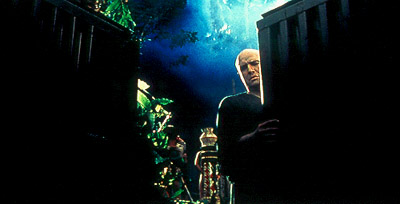
While you guys are thinking about your favorite characters for our new character depth study, here’s some subtext food-for-thought. (I knew that as soon as I posted a celebration of our subtext study, I would think of another great scene. In fact, I thought of 4. I will post the others when I get a chance. Sigh...)
This is really about the fine art of not preaching to the audience.
Redux was genuinely fascinating. (As we all know, this adaptation to Heart of Darkness was, of course, penned by John Milius and Francis Ford Coppola. They also brought in Michael Herr to write Willard's voice overs. You can get the script here.)
My only complaint about the new version was with the French Plantation sequence. The dinner scene was masterfully filmed (and I loved how Coppola made the beautiful Aurore Clément stand out by not having her say anything). However, all of the political statements made by the various members of the Marais family over the course of that dinner felt flat to me because it was all so completely on-the-nose. Apocalypse Now was many things but it was NEVER straightforward verbally with the statements it was trying to make about the war.
There was a scene, though, that Coppola added, which I thought was really brilliant with its use of subtext. After Willard finds Kurtz, he is thrown into a metal box called a “Conex Container.” He bakes inside this box for a time and wakes to find a group of children looking at him through the holes of the container. (If you look closely, you can see Kurtz peering through one of the holes, too, as if he is one of the children.) In any case, Kurtz opens the doors, sits down on the steps, and has some discourse with Willard about the war.
Amateurs would’ve faltered here. Amateurs would’ve forced Kurtz into giving a grandiose speech about the absurdity of the Vietnam war. Not Coppola. He uses subtext to great effect here. Instead, Kurtz says nothing about what he really thinks. He simply reads an article, a REAL article that was published in Time magazine, which had said, in effect, that the Americans were WINNING THE WAR.
In the Redux Commentary, Coppola said, “In a way, you know, cinema is more like poetry than literature. It’s all about expressing things and saying things that you don’t say and trying to say it in another way – to use metaphor, or simile, or allegory or any of these other poetic techniques where you express one thing by, in fact, showing something quite different – and the audience puts it together. Cinema is at its best when it expresses things without really expressing them.”
To that, I say, “Amen.”
-MM
INT. CONEX CONTAINER - DAY
Willard is passed out, lying on the floor of a metal CONEX CONTAINER. It is hot. Some CHILDREN are peeking in at him.
The two front doors of the container are opened. Light floods in. Kurtz is standing there with the children. He holds a bunch of magazine articles.
He sits down on a dirt step, surrounded by children.
He looks down at a magazine article and begins to read it to Willard.
KURTZ
(reading)
"Time magazine. The weekly news
magazine. September 22, 1967,
volume ninety, number twelve. The
War on the Horizon. The American
people may find it hard to believe
that the U.S. is winning the war
in Vietnam. Nevertheless, one of
the most exhaustive inquiries into
the status of the conflict yet
compiled, offers considerable
evidence that the weight of U.S.
power, two and a half years after
the bug buildup began, is beginning
to make itself felt. White House
officials maintain the impact of
that strength may bring the enemy
to the point where he could simply
be unable to continue fighting."
(to Willard)
Is this familiar?
Willard reacts.
KURTZ
(reading)
"Because Lyndon Johnson fears that
the U.S. public is in no mood to
accept its optimistic conclusions,
he may never permit the report to
be released in full. Even so, he
is sufficiently impressed with the
findings, and sufficiently anxious
to make their conclusions known,
to permit experts who have been
working on it to talk about it in
general terms." No date, Time
Magazine. "Sir Robert Thompson,
who led the victory over the
Communists guerrillas in Malay,
and who is now a RAND Corporation
consultant, recently returned to
Vietnam to sound out the situation
for President Nixon. He told the
president last week that things
felt much better, and smelled much
better over there."
He looks over at Willard.
KURTZ
(to Willard)
How do they smell to you, soldier?
Willard doesn't answer. Kurtz rises. The children are laughing and giggling. Kurtz drops the magazine articles in Willard's lap.
KURTZ
You'll be free. You'll be under
guard. Read these at your leisure.
Don't lose them. Don't try to
escape, you'll be shot. We can
talk of these things later.
Kurtz turns and exits, closing one of the doors, leaving the other open. Willard watches him go. The children stay, looking at him, laughing and giggling. Willard slowly and painfully pulls himself to his feet. He stands there a moment looking at the children, then collapses to the floor.