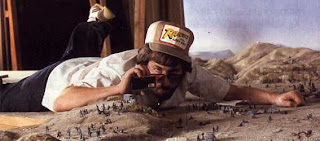
Monday, March 09, 2009

The “Raiders” Story Conference


Hey, guys, you’re going to love this (and thanks, Viktor).

There is a
link now available to download the 125-page transcript (in the form of a .pdf document) of the original 1978 story conference between Steven Spielberg, George Lucas, and Lawrence Kasdan for a little film called Raiders of the Lost Ark.

Some background first. Spielberg suggested that Kasdan write Raiders because he admired his Continental Divide script. Lucas agreed. Now, imagine with me: Lucas had just released Star Wars, the biggest film in the history of Hollywood and a cult phenomenon. Spielberg had just released Close Encounters of the Third Kind and before that, Jaws. Now Kasdan was called in to have a story conference with the biggest names in Hollywood who wanted to talk about their next blockbuster. The conference took place at the L.A. home of Jane Bay, who was Lucas’ assistant. They had 5 consecutive 9-hour days to talk about the story. This .pdf is a transcript from taped recordings of those meetings.

By the time Lucas and Spielberg setup these meetings with Kasdan, they knew for the most part what they wanted. This was just a matter of “okay, so, how do we tell this story?” Lucas did most of the talking. He seemed to be just talking through all of the ideas. He came across as, on the one hand, a strong driving force behind the film and on the other hand, a bit controlling. Spielberg occasionally threw in some exciting, funny, and even wacky ideas, which at times Lucas tried to dial down. But many, if not most, of Spielberg’s ideas would be used. Kasdan doesn’t say too much. I imagine he’s just soaking in everything he’s hearing, but he was certainly in sync with the filmmakers. He'd occasionally interject suggestions and also good questions about logic, characters, and plot.

Man-oh-man, Spielberg and Lucas were idea machines. They could’ve sat there coming up with Indiana Smith ideas forever. There were enough ideas generated in these meetings for two films, which they actually used for two films. I must say, it’s rather unusual to have meetings with a producer and a director and be given so many ideas. Not that meetings with producers and directors wouldn’t have a lot of ideas but I’m not sure you would encounter such a volume as this. For screenwriters, it’s a goldmine. If you try to forget the finished film and put yourself into Kasdan’s shoes and you have all these ideas thrown at you, it can be a daunting task. What do you keep? What do you throw away? How do you make all this work?

In any case, there were about 10 Screenwriting Lessons I took away from this experience and thought they might be worth sharing.


1) Before they ever discussed the plot, they figured out who and what their hero-protagonist is and how he'd be similar and also different from other heroes in cinema.

The story began with the character, which was integral to the concept. So much was said that it’s hard to condense, but here’s a taste:

(Key: G = George; S = Steven; L = Larry)


G — The thing with this is, we want to make a very believable character. We want him to be extremely good at what he does, as is the Clint Eastwood character or the James Bond character. James Bond and the Man With No Name were very good at what they did. They were very fast with a gun. They were very slick. They were very professional. They were Supermen.

S — Like Mifune.

G — Yes, like Mifune. He's a real professional. He's really good. And that is the key to the whole thing. That's something you don't see that much anymore.

Later:

G — He's the guy who's been all around the world. He's a soldier of fortune. He is also... Well, this gets into that other side of his character, which is totally alien to that side we just talked about. Essentially, I think he is a, and this was the original character and it's an interesting juxtaposition. He is an archeologist and an anthropologist. A Ph.D. He's a doctor, he's a college professor. What happened is, he's also a sort of rough and tumble guy. But he got involved in going in and getting antiquities. Sort of searching out antiquities. And it became a very lucrative profession so he, rather than be an archeologist, he became sort of an outlaw archeologist. He really started being a grave robber, for hire, is what it really came down to. And the museums would hire him to steal things out of tombs and stuff. Or, locate them. In the archeology circles he knows everybody, so he's sort of like a private detective grave robber. A museum will give him an assignment... a bounty hunter.


Later:

G — I think basically he's very cynical about the whole thing. Maybe he thinks that most archeologists are just full of shit, and that somebody's going to rip this stuff off anyway. Better that he rips it off and gets it to a museum where people can study it and rip it off right. That's the key also. He knows how to enter a tomb without destroying it. He knows what's important. He knows not to go in there like a bull in a china shop and destroy half the stuff that's valuable.

And later:

G — It's such an odd juxtaposition, especially going around. The first sequence is in the jungle and you see him in action. You see him going through the whole thing. And the next sequence after that you see him back in Washington or New York, back in the museum. Where he's in a totally academic thing, turning over this thing that he's got. Then in the rest of the movie you see him back in his bullwhip mode. You understand that there's more to him. Plus, it justifies later things that he... the fact that he's sort of an intelligent guy. Peter Falk is one way of looking at him, a Humphrey Bogart character. The fact that he's sort of scruffy and, not the right image, but...

S — Peter's too scruffy.

G — Yes. We'll figure a way of laying that out in his personality so it's easily identifiable.

S — Remember the movie Soldier Of Fortune with Clark Gable? There was a good deal of Rhett Butler in that character. The devil-may-care kind of guy who can handle situations. He's so damn glib he bluffs everybody around. People think that he's a push-over. He's challenged, and he always appears like a push-over. But in fact he's not. He likes to set himself up in these subordinate roles from time to time to get his way.

G — What I'm saying is that character just would not fit in a college classroom or even as an archeologist. He's too much of a scruffy character to settle down. A playboy, or however you want to do it. He's too much of a wise-guy, maybe that's a better way to say it, to actually be a college professor. He really loves the stuff, but he became too cynical, he's too much of a wise guy to fit into an academic situation, or even an archeological situation. He's really too much of an adventurer at heart. He just loves it. So he obviously took this whole bent that was different because it's just more fun. He just can't settle down. It's a nice contrast. It's like the James Bond thing. Instead of being a martini drinking cultured kind of sophisticate, he's the sort of intellectual college professor James Bond. He's a superagent.

S — Clark Kent.

G — Yeah. It's that thing, which is fun. It's the same idea, only twisted around a little bit...

On the name:

L — Do you have a name for this person?

G — I do for our leader.

S — I hate this, but go ahead.

G — Indiana Smith. It has to be unique. It's a character. Very Americana square. He was born in Indiana.

L — What does she call him? “Indy?”

G — That's what I was thinking. Or “Jones.” Then people can call him “Jones.”


2) A character arc? What's that?

There was also no discussion about an arc, and as you can see, they referenced characters that did not arc, such as James Bond, the Man With No Name, Superman, and some of Clark Gable’s characters.


3) A racy backstory can keep a plot moving.

Interestingly, the discussion about Marion was hardly as thorough as the one about Indy. For a while, they weren't sure what kind of girl to have as a counterpart to Indy. Lucas had first described the love interest as a blonde double-crossing German agent, which they ended up using in Last Crusade. Spielberg said, “She should have hair like Veronica Lake. You only see one eye at a time.”

There was talk about a big name professor who taught Indy everything he knew. Then there was the idea about this German girl, and for the sake of expediency, Kasdan suggested that Indy instead have an affair with the mentor’s daughter, which they loved. And then Lucas and Spielberg were off and running with ideas about how’s she’s been left in Peru and has this bar and is trying to get money together to get back to the States and loves (and resents) Indy to no end. In fact, Kasdan said he wanted Indy and this girl to already have a history when they meet because, “I like it if they already had a relationship at one point. Because then you don’t have to build it.” Hehehe

Then the discussion turned to how old Marion and Indy were at the time of the affair:

G — I was thinking that this old guy could have been his mentor. He could have known this little girl when she was just a kid. Had an affair with her when she was eleven.

L — And he was forty-two.

G — He hasn't seen her in twelve years. Now she's twenty-two. It's a real strange relationship.

S — She had better be older than twenty-two.

G — He's thirty-five, and he knew her ten years ago when he was twenty-five and she was only twelve. It would be amusing to make her slightly young at the time.

S — And promiscuous. She came onto him.

G — Fifteen is right on the edge. I know it's an outrageous idea, but it is interesting. Once she's sixteen or seventeen it's not interesting anymore. But if she was fifteen and he was twenty-five and they actually had an affair the last time they met. And she was madly in love with him and he...

S — She has pictures of him.


And now consider the dialogue of that scene in the film:

INDY: I never meant to hurt you.
MARION: I was a child! I was in love.
INDY: You knew what you were doing.
MARION: It was wrong. You knew it.
INDY: Look, I did what I did. I don't expect you to be happy about it. But maybe we can do each other some good.
MARION: Why start now?
INDY: Shut up and listen for a second. I want that piece your father had. I've got money.
MARION: How much?


4) Consider the debate about un-sympathetic protagonists.

At one point, they figured out that he’d go to Marion to get a pendant thingee, a puzzle of some kind that her father collected and will help Indy find the Ark. But she doesn’t want to give it to him. And she goes with him on this adventure. So then the question became, how does he get this thing from Marion to solve the puzzle?

They tossed around an idea about him stealing the pendant from her, which prompted a short debate about un-sympathetic protags:


G — It would be nice if they left in a huff, they fought or something. He left rather pissed. I don't think he would leave without the pendant. That's the only thing that bothers me about that.

S — So he goes upstairs and stays up, plotting how he's going to take it off her.

G — That makes him into a real rat.

L — That's all right. He never does it. What he does is just the opposite, save her life.

G — No matter how you do it, the fact that he thought about it is the rat part.

S — Rhett Butler was a rat.

G — He wasn't a real rat --

S — He proved himself by raising her family. Before that he was a gambler, dealt with cheap ladies.

G — There's a difference between being a rat and somebody who's having fun. He never hurt anybody.

L — I'm a little confused about Indiana at this point. I thought he'd do anything for this pendant.

G — But he still has to have some moral scruples. He has to be a person we can look up to. We're doing a role model for little kids, so we have to be careful. We need someone who's honest, trusting and true. But at the same time he's confronted with this difficult problem. We have a great thing when she won't give it to him. She doesn't like him.

L — What if you see them separate, and you see them both thinking about it, and it's clear that she's going to give it to him. Then he saves her and she doubts his motivation, was he coming to steal it? Or was he coming to rekindle the romance? It doesn't have to be crystal clear to her.

Interesting to me that they didn’t have a debate about un-sympathetic protags when they were talking about Indy having an affair with the underage daughter of his mentor. That builds sympathy how? But they’re terribly concerned about losing sympathy if we might watch Indy consider stealing the pendant from Marion. (Also, here, Lucas and Spielberg were both projecting their own unique feelings onto Rhett Butler. Rhett WAS a cheating rat and he never once redeemed himself with that dysfunctional family he created. He spoiled the hell out of his wife and his little girl, which was in part why she died.)

However, I think there might be some screenwriting nuggets here. What happens in the past, off screen, good or bad, does not affect sympathy. It’s what we see the character do in the present that determines how much we will or will not care about that character.


5) Consider how tension was always a high priority as they laid-out their plot for the film.

The first scene was all about building the tension to a big payoff, which was a boulder as Spielberg suggested. But you had to set that up first and work your way backwards. So going backwards, you create tension with the near betrayal against Indy when he put the map together and had to use his whip on the man that pulled out the gun. You have the fresh poison darts of the Hovitos. You have his entourage not going any further when they reached the stone sculpture of a Chachapoyan demon. You have tarantulas. You have the dead competitor in the Chamber of Light. You have the pit. You have the dart floor in the Foyer of the Sanctuary. And then you have the big payoff to all the big danger that all of these details setup.

The consideration in Act Two was about maintaining tension. Here are highlights of comments George made…

G - People are trying to kill him as soon as he arrives or maybe even before he arrives on the airplane. As soon as he gets there, there are knives coming out of walls, all these slimy characters are following him, all that stuff that happens in those places in the thirties…

…There's a lot of tension because we have established that everybody is trying to kill him. People are following him all over the place…

…The idea in the middle sequence was to create sort of a race, tension, who's going to find the Ark first situation.


So much of the tension and gags was a matter of backtracking. Consider how Indy is finally underground in the temple. He found the Ark and had it hoisted up. At this stage of development, the temple was not full of snakes. The Germans grab the Ark and seal Indy inside to die. So what do you do with Indy then?

How do you raise the tension and suspense in this scene and also find a way for him to escape? They first decided that the temple be suddenly filled with water and Indy floated up to a place where he figured out how to escape. This idea could be setup with Indy entering a sand temple and there's moss on the walls. But will audiences believe that there could be so much underground water in a desert? Lucas suggested setting that up verbally by talking about an underground water system. Nah. How about filling the temple with sand? Nah. Then Spielberg suggested that the Germans lower hungry lions into the temple to kill Indy, which would give him the chance to use his bull whip. Nah. How about rats? Or how about snakes? Hundreds of thousands of snakes. It could be a giant snake pit.

And then they were off and running about the snakes in the temple.

S — It would be funny if, somewhere early in the movie he somehow implied that he was not afraid of snakes. Later you realize that that is one of his big fears.

G — Maybe it's better if you see early, maybe in the beginning that he's afraid: "Oh God, I hate those snakes." It should be slightly amusing that he hates snakes, and then he opens this up, "I can't go down in there. Why did there have to be snakes? Anything but snakes." You can play it for comedy…

So then they go back to figure out when and how you can setup the snake joke in the opening sequence. A lot of screenwriting is backtracking, of setups and payoffs.
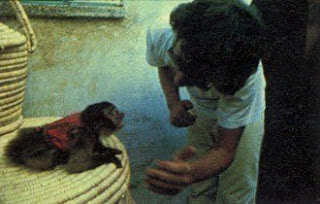

6) Consider their approach to exposition.

So Indy’s in Cairo with his friend. We're at a scene that we know will be full of exposition, that is, the Staff of Ra was too long for the Germans and they’re digging in the wrong place. So the question was, "what are we going to do to make the scene interesting so the audience doesn’t fall asleep?" And the idea was presented that this exposition could be done over dinner that’s been poisoned. As they pick up tainted food and gesture with it, we fear for their lives. They loved it. (And I've been saying this for years - great exposition is always given in the context of something else.) Okay, now that we have the setup, how do they figure out the food is poisoned and survive? A pet nibbles on it and dies. Okay, what kind of pet?


S - What if it's an animal we hate, an animal the audience can't stand. It's always after our hero and doesn't like him very much, like a mongoose.

G — A monkey is a perfect thing.

S — What animal don't people like?

G — A rat.

S — A pet rat.

G — It doesn't have to be a pet.

L — He's looking the other way, the rat comes up.

S — That's a pretty brave rat.

G — It wouldn't come on the table.

So then they’re off and running about this pet monkey. Why is the monkey here? Is it a family pet? Maybe it just attaches itself to one of the characters and won’t go away. Is it dressed up like a circus monkey? Perhaps it’s secretly helping a German agent? Well, what kind of bad things can a monkey do for a German agent? It was hilarious. I was rolling. But ya know, figuring out those details is crucial to a script. Finally, at one point, Spielberg suggested that the monkey humorously do the “Heil, Hitler” gesture. Lucas responds, “That's up to you and the trainer and the monkey.” Hehehe...

They had to be laughing as they were talking about this.

So we’re back at the dinner scene. The exposition about the Staff of Ra will be fed to the audience in the context of Indy possibly eating poisoned food. It’ll be a bad secret agent monkey that eats the food and dies. Spielberg had a hilarious suggestion that I loved:

S — …it would be funny if, as they're talking about this and the olives are between them, you see a hairy little paw is pulling olives off the plate, coming in and out of frame. Finally the paw comes up to grab an olive and begins slipping, like palsy. You use a little mechanical paw. And then you hear a thump.

Of course, the final result was the quick "bad dates" scene. All of that thought and work for something so quick. Welcome to Hollywood.


7) No idea is a bad idea when you’re brainstorming.

These guys were all over the place with ideas and there’s nothing wrong with that. As I mentioned earlier, many of the ideas discussed, like the plane crash sequence and mine cart chase, were used in the second film. So what helped determine which sequence should be kept and thrown away? Redundancies in concept. You already had a chase scene here, so why have another one here? Let’s come up with something different. You know? That kind of thing.

At one point, when the bad guys had captured Marion, they were debating what to do next.


G — What can he chase them with? What if he jumps on a camel?

S — I love it. It's a great idea. There's never been a camel chase before.

L — Is this camel going to chase a car?

S — You know how fast a camel can run? Not only that, he can jump over vegetable carts and things. It could be a funny chase that ends in tragedy. You're laughing your head off and suddenly, "My God, she's dead."


Also:

S — We still have the big fight in the moving truck to do. And now we have a camel chase.

G — We've added another million dollars.

S — Not really. How much trouble can a camel be?

Hehehe


8) Consider their approach to budget.

Keeping the film cheap was a way of testing the idea of Indiana Smith. Lucas said, “Part of it is the energy of making it reasonably low budget. It’s also a test of the idea. If it’s good, then we’ll be okay.”
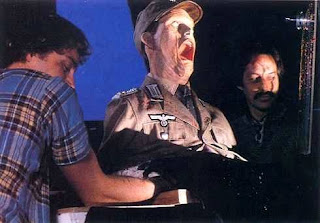

9) Consider their approach to the ending.


G — If you follow classic dramatic plotting, that's what is going to happen. You put your biggest boom last, and you create as much tension as you possibly can.

I’ve also been saying this for years, what I coined, “The Big Bang Theory of Screenwriting.” If you’re going to have a big bang in the beginning, you sure as hell better have a bigger bang in the end.

There was a lot of discussion about the ending and ideas about how to make it bigger than the opening sequence. This involved a sub to a secret island, the ritual with the Ark, everyone getting fried, Indy saving Marion, a mine cart chase back to the sub, and somehow the entire island completely blowing up. Interesting how early concepts had Indy much more active about resolving the conflict and yet how strangely satisfying the ending is with Indy just closing his eyes.

And finally:
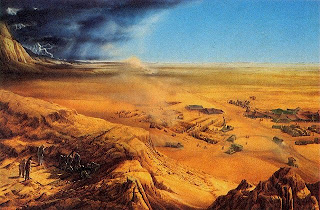

10) Consider the transcript as a whole, the sheer volume of thought, discussion, analysis, questions, and debate about the story before they ever sat down to write the script.

It’s like what
Billy Wilder said, “You always start with too many ideas.”

Raiders looked deceptively simple and easy and fun, but the story required so much more thought than you can imagine. The good films always make everything look so easy but they never are. And I suspect that many aspiring writers fail because they jump into their stories with too few ideas, without brainstorming first, without outlining, and without really thinking through the story. Certainly not to this degree as we see in these story conferences. And so the question is, “Have you put as much thought into your story?”

Let me conclude with this anecdote from
Raider.net:

By August 1978 Kasdan had
finished his first draft and hand-delivered it to Lucas. When they met Lucas took the script, laid it aside, told Kasdan that he would read it later that night and offered him to go for lunch. During the lunch in the restaurant, Lucas offered to Kasdan to write the script for The Empire Strikes Back. Unfortunately, Leigh Brackett, the film's writer had passed away right after delivering her first draft and Lucas wanted someone to make revisions. "Don't you think you should read Raiders first?" was Kasdan's reply. "Well, I just get a feeling about people. Of course if I hate Raiders, I'll take back this offer," said Lucas. The next morning, Lucas called Kasdan and told him he was ecstatic about the Raiders script and he was very anxious for him to work on Empire.

Thursday, March 05, 2009

Watchmen & Visual Irony


We finally get to see that really short Watchmen movie this weekend!

Woo hoo! Hehehe

I had thought about writing a number of different articles on the Watchmen but there’s very little I could add to the discussion about the superb graphic novel that isn’t already explored
here as well as the Podcasts I referenced earlier. You can also catch quite a list of other great links at IFC’s Watchmen Round One and Round Two.

Let me say, there are many rewards for screenwriters by listening to the
Watchmen Podcasts, and I’ll tell you why. These guys go through each issue panel-by-panel discussing not only the story but all of the visual details as well. This really could help you to not only develop your own visual vocabulary but also think more in terms of visual storytelling, which was all quite inspiring for me at least.

For example, I loved the many, many transitions between scenes. I loved the many visual metaphors at play in the narrative, like outside of Hollis’ place where there was always that sign for the “closed” mechanics shop who can “fix ‘em” and “obsolete models a specialty!” Or like when (in Chapter III, page 9) Laurie was talking to Dan in his kitchen about how people have become (to Dr. Manhattan) just “shadows in the fog,” while visually her face is blurred by the steam from the kettle. Or how, later in the chapter from page 12-15, Dr. Manhattan is verbally “attacked” by the press during a talk show while Laurie and Dan are physically attacked in an alley by thugs. And I loved how, on page 15, you have government guys escorting Dr. Manhattan out of the studio while the press swarm around them and one government guy says, “C’mon, the mob’s getting aroused,” and then they cut to Dan and Laurie aroused and looking at each other after the fight. And then the government guy says later, “Gentlemen, I think it safest not to pursue this line of thinking,” and they cut to Dan and Laurie turning away from each other to avoid hooking up. And I also loved the first few pages of Chapter VIII, which opened with Sally and Hollis having a phone conversation but you don’t see their faces. You look at the memorabilia in both of their apartments from days gone by when they were both members of the Minutemen as they speak about days gone by over the phone. The knick-knacks are sentimental just as their conversation is sentimental about the old days and how they’ve changed. And then the panels reveal how they’ve changed in ways that they aren’t saying over the phone, Hollis with his cigarettes and alcohol, and Sally with her vitamins. Hollis mentions a tight budget and Sally responds about how they’re all feeling “the pinch nowadays” and all the while she’s getting a professional manicure done. Hehehe

And some of you might be thinking, “Has MM lost his mind? Those are visual flourishes that the director should figure out. I just have to write the story.” Wrong. Screenwriters are filmmakers, too. It isn’t enough to “write a story.” You have to render that story cinematically.

More on that topic
here.


But there’s one aspect I would like to discuss – visual irony.

Nobody ever says this but contradictions are where it’s at in drama. In a story, you typically have two opposing forces, a protagonist vs. an antagonist, and they generally contradict each other in terms of goals and tactics and philosophy. Drama is born from contradicting motives, words, and actions. Of course, finding drama through contradictions between characters can also be used to great effect in love stories. Opposites attract, right? Not only that, contradictions within the characters themselves is how you create
depth, that is, a character can have contradictory sides to his/her nature. For example, there was Hamlet, who was both spiritual and blasphemous, loving and sadistic, courageous and cowardly, cautious and impulsive, proud and self-pitying, witty and sad, weary and dynamic, lucid and confused, and sane and mad. There can be layers of contradictions between what a character says and what a character really thinks. Exploiting a character’s contradictions is also a way to craft inner conflicts. You have two opposing needs in a character that eventually puts that person in a difficult position where he or she has to make a choice.


But there’s a whole other level of contradictions in the way that you tell your story – Visual Ironies. It’s that contrast between two things you see on the screen or it’s a contrast between words and images. And when it comes to the Watchmen visual contrasts is what makes so much of the imagery interesting, all of which begins with the blood-splattered smiley face. The smiley face pin on its own gives off very fun, happy vibes. Add a splotch of blood on the button, and you have a more layered, twisted, perversion of meaning. I loved what Dr. Spiros Xenos wrote in his essay on
Reading Space in Watchmen:

Tracing the smiley face symbol in its various manifestations reveals the manner in which minor and occasional details accumulate and add pressure on the paranoia/determinism axis of the text. Watchmen begins with a close-up of the smiley badge lying in the gutter, the smear of blood crossing the right eye in the manner of a clock hand approaching 12 o’ clock. Rorschach’s diary entry notes his apprehension of the city’s “true face”. It is clear Rorschach is not referring to the badge at this point, but it is equally clear that we, the omniscient reader, recognise the proximity of the two levels of narration, that is, the ‘face’ of the city as smeared with blood, and Rorschach’s unconscious registration of the badge as pertinent symbol. Moore refers to this double-tracking as a

sort of “under-language” at work ... that is neither the “visuals” nor the “verbals,” but a unique effect caused by a combination of the two. A picture can be set against text ironically, or it can be used to support the text, or it can be completely disjointed from the text - which forces the reader into looking at the scene in a new way.... the reader has the ability to stop and linger over one particular “frame” and work out all of the meaning in that frame or panel...

Lewis refers to the overlay of text and image in Watchmen as “harmonic counterpoint”, which aptly registers the effect of the quotation of visual symbols throughout the text. In his account the smiley badge represents repression, blocked vision and denial. The smear over the right eye symbolises willful blindness and denial...


I totally agree. At the same time, it could also represent a false facade, the happy image that masks the hidden, sinister motives underneath. That’s visual irony. That’s the combination of two contradictory images, in this case, blood and a smiley face, to create something layered and complex and unique. It’s a detail that adds weight to the story.

I also discovered this fabulous essay by Dr. Biljana Scott from the Centre for Linguistics and Philology at the University of Oxford. It’s called
PICTURING IRONY: the subversive power of photography. He talked about a variety of different forms of visual irony, but for the sake of this discussion, I’d like to break it down into two categories: 1) Word-based visual irony and 2) Image-based visual irony.


1) WORD-BASED VISUAL IRONY

I love this. This is where there is a contradiction between what is being said and what we are seeing. What’s the value of this technique? It’s a way of making statements about characters, about relationships, and about society without having to verbalize what’s happening. And the first script that comes to my mind when talking about word-based visual irony is
Kubrick’s Napoleon. I say this not because it’s the greatest script ever, but because I studied it so intensely and admired many techniques in the script. So often in his story, Stanley would try to exploit what we were seeing vs. what we were hearing…

We see the happy wedding of Napoleon and Josephine while we hear in voice over Josephine reveal her true feelings of lukewarm indifference to Napoleon. In a later sequence between Napoleon and Josephine, we hear Napoleon’s endless love for Josephine, but we see the painful reality of their marriage in the form of Josephine’s torrid affair. During the Italian campaign, we hear the Narrator tell us about all the glories and victories of Napoleon while we see French troops pillage small Italian towns and take away food and livestock from poor farmers. We hear Josephine read her statement declaring how she feels pleasure giving Napoleon “the greatest proof of attachment and devotedness that was ever given on earth,” that is, a divorce, but yet, we also see her sobbing uncontrollably.

In Watchmen, you had, as I mentioned earlier, Sally pretending to Hollis over the phone that she’s feeling the “pinch” as everyone else is, but visually, we know that’s not the case for her. She’s getting her toes professionally manicured. In the last few pages of the first Chapter, you had Dan and Laurie telling each other everything’s fine in their lives and acting like they don’t care for each other, although we see that they are in a romantic setting and leaning in to each other. I loved how, in Chapter III page 2, we would hear Sally say, “Life goes on, honey. Life goes on,” while we look at Rorschach holding a sign that says, “The End is Nigh.” Or when we hear Sally say, “In the end, you just wash your hands of it,” but we’re looking at Rorschach’s hands holding the sign and the ink from his “The End is Nigh” words have run down to his hands. He will not wash his hands of this.

Dr. Scott’s article had some interesting examples, too. Consider this image by Margaret Bourke-White:


This was taken during the 1930’s, has a big billboard that “
depicts a white American family of four, well dressed and smiling happily as they drive along in a new car. The strap-line at the top of the poster reads: ‘World’s Highest Standard of Living’, and the text on the ad reads: ‘There’s no way like the American way’. Beneath the billboard stands a breadline of cold and ragged looking black Americans, queuing for handouts. The contrast between the way of life projected by the billboard, and the actual conditions endured by the poor people standing in its very shadow could not be more literal: whereas the idealised Americans are healthy wealthy and white, the actual Americans in this photograph are underfed, impoverished and black. Bourke-White’s photograph offers a clear illustration of a contradiction between what is said and what is shown, of the discrepancy between the expectations set up by the advertisement and… reality.

Consider this one:


This is “
Elliott Erwitt’s Versailles, 1975, which shows part of a gallery with gilt frames on the wall. In one frame we see a classical portrait of a nobleman, next to it the large frame contains what appears to be a small slip of paper. Three people stand in front of this frame gazing intently at the paper. Nobody is looking at the pictures. The image is ironical because it flouts our expectations that people go to art galleries in order to look at the pictures which are there (rather than to read the notices informing them as to why a picture is no longer there). It may even be that the adage ‘a picture is worth a thousand words’ comes to mind, providing the target of echoic mention which the visual evidence then undermines. The most striking difference between these two renderings of a similar topic is that Kruger uses words and uses them ‘in your face’ whereas Elliott eschews words and depends on implication exclusively. Kruger’s irony is earnest, possibly even aggressive; Elliott’s is irreverent and amusing.

Here’s one that needs no explanation:


Or this one, escalators going up to a fitness center!


2) IMAGE-BASED VISUAL IRONY

This is where you have two contradictory elements without words. In Watchmen we have the blood-splattered smiley face.

Dr. Scott’s article had this photo:


A broken bicycle that’s obviously been run over lies on a marked bicycle path, which indicates to us that it’s obviously not as safe as the bicycle symbol on the street would have you believe.

I remember writing about Banksy who would take an image like a famous Monet painting and throw in a splash of contemporary reality:


Or he would take something ugly like the wall between Palestine and Israel and try to add something pretty/hopeful to it.


Let me end on this last photo. Is it condemning or hopeful?


Wednesday, March 04, 2009

Unproduced Hitch: Complete Series


Hey guys,

As many of you know, I just wrapped up my series on the Unproduced Screenplays of Alfred Hitchcock and I thought I’d repost links to all of the articles for those who may be new to the blog. There’s a lot of great material here. A study of Hitchcock is absolutely crucial to every screenwriter. Hitch will change the way you write and view cinema.

This series was inspired by the Key to Reserva (above), as well as David Freeman’s book, The Last Days of Alfred Hitchcock, and another wonderful book I read last year, Steven DeRosa’s Writing with Hitchcock. Of course, like any study I have, I may still add articles to this from time to time if I ever feel so inspired.

In any case, hope you enjoy it.


-MM

---------------------------

The Man Who Made Movies

Unproduced Hitch: The Complete List

Hitchcock, Cinema's Purist

The Derosa Links

The Exposition of Rear Window

Tension & Suspense Blog-a-thon

Elements of Suspense

Peet Gelderblom's
Alternatives to Suspense

Hitchcock Goodies for Cinephiles

Two Fabulous Unused Hitchcock Ideas

1939 Alfred Hitchcock Lecture

John Michael Hayes, Lucky Bastard

Script Review - The Short Night

1964 Hitchcock Interview

A murder scene written by - Hitchcock!

Script Review - Mary Rose Part One & Part Two


Tuesday, March 03, 2009

“Mary Rose,” Part Two


(Click here if you missed Part One.)

To conclude my script review, I’d like to share six personal insights that I took away from the Mary Rose experience.

* First and foremost, there is magic in the fun, playful dialogue of J.M. Barrie’s characters. It’s infectious. At the ripe young age of sixty, Barrie was still having fun with his powerful imagination and bringing his brand of playfulness to the proceedings, as if, “hey, everybody, let’s have fun together!” Too many of us are too damn serious with our scripts, and we’ve forgotten to have fun or to bring a sense of joy to our work. And when Barrie’s plays turn emotional, or even tragic, there is a great tenderness to his approach that I found so refreshing. Even when we’re in the midst of the tragedy of Harry speaking with his ghost of a mother, he could’ve turned bitter and angry about it all, but no. He is good-natured about it. He cares about helping her. He makes the most of his time with her, and in the process, we go through this kind of tender therapy about letting go a loved one.

* Mary Rose proves that logic isn’t as important as emotional content. The island makes no sense whatsoever. But, ya know, we recognize the themes contained in the story, the emotions the characters are feeling about losing a loved one, about letting go, and the play hits all the right emotional points where it counts: the fun in the beginning, the sadness of loss, and sense of liberation in the end. We go to feel and because J.M. Barrie makes us feel something, we give ourselves over to the story – even when it doesn’t make a damn bit of sense.

* I don’t blame the studio for passing on the script. In its present form, I would’ve passed on it as well. The magic of the third act does not compensate for all horribly static scenes that preceded it. But, ya know, I also came up with a fun creative writing exercise - to imagine all the ways that I could break up those excessively talkative scenes, especially those first two scenes, to make it more visually stimulating, while also honoring Barrie’s playfulness. I may return to that periodically as a writing exercise for myself.

* Another aspect that bothered me about Jay Presson Allen’s script was not only the excessive amount of dialogue in those first two scenes but the dialogue itself. She covers all of the necessary plot points of the story (and in many cases points that never needed to be made) but what she failed to capture was the playfulness of the words themselves. This script was more about resuscitating Hitchcock’s career than it ever was honoring Barrie’s craft, and some really treasured elements of the play would’ve been lost in transition.

* While I didn’t like the way they handled it, I admired the decision to actually show Mary’s death after her return from the island. That was not in the play. I can’t help but wonder how I would handle it. Once she sees that Harry’s missing, she should try to run away. Then some kind of accident, perhaps, falling down the stairs? I’m not sure.

* I have to say that Hitch and Allen made all the right decisions about the third act. In fact, the way that they handled Kenneth’s conversation with his ghost mother is very close to how I believe I would’ve approached the ending. In the play, the conversation sort of reaches an impasse. He didn’t know how to get rid of her. She didn’t know how to leave. Plus, they weren’t sure where she could even go. And after a bit of time, she gets sleepy and the island takes her back. In the script, Mary wants to go back to the island, and that is far more satisfying. Also in the script, he’s a bit more forthright about being her son, although she never figures it out, which was good. That scene would’ve never worked if she realized he’s her son. It would’ve lost that magic. One thing I would change. I would’ve had Kenneth/Harry ask her to please stay a little bit longer… and then let her go.

Sunday, March 01, 2009

Script Review – “Mary Rose”


Hello, my friends,

This is the first of two final posts on what may have felt as a never-ending series on the Unproduced Screenplays of Alfred Hitchcock.

Woo hoo! Hehehe...

This was the film Hitch purportedly wanted to make more than any other but the studios always refused. Biographer
Donald Spoto said that Hitch’s failure to make this film was “perhaps the single greatest disappointment of his creative life.” Hitch would say repeatedly in interviews that his contract with Universal allowed him to make any film so long as it cost under $3 million and so long as it wasn't Mary Rose. Of course, this was never verified and probably not true. In truth, the reasons why this didn’t happen are complicated, involving the Tippi Hedren fallout, the failure of Marnie, Hitch’s career crisis, and concerns about audience expectations of Hitch at the time.

In any event, Mary Rose was originally a play by
J.M. Barrie (of Peter Pan fame) that Hitch had seen in his youth and loved dearly. In fact, he saw the original production at London’s Haymarket Theatre and was so enraptured by Fay Compton’s performance as Mary Rose that he cast her as the countess in his 1933 film, Waltzes from Vienna. When he was preparing to produce Mary Rose in the early 60’s, he inquired about Compton’s availability (probably to play Mrs. Morland or Mrs. Otery). According to Dan Auiler, during the production of Vertigo, Hitch had sought out from England the play’s original score and sound effects, which he sent to his composer, Bernard Herrmann, for inspiration. (The “call” that prompts Mary Rose's disappearance, which I’ll write about in a bit, was created with bagpipes and “wordless voices” played on a musical saw. Hitch described the sound as “celestial voices, like Debussy's Sirenes.”) Hitch also clung to the rights of the play until 1987 well after his death. He commissioned the only screenplay for Mary Rose (on his own without studio approval and without a greenlight). The script was written by Jay Presson Allen, who wrote the final draft of Marnie. The screenplay can be read here, thanks to Derosa’s Writing with Hitchcock website. (Be warned: the script is a huge 21 MB file.)

Let me just say, when I first went through the script, I couldn’t believe what I was reading. The first twenty pages was the most awful, talkative, static scene I’ve ever encountered in a script and never imagined I’d find in any kind of Hitchcock project. It was two people talking in a room, and it went on and on and on... I thought the damn scene would never end. The next scene was more people talking in a room, which went on for another thirty pages or so. This was followed by a visit to a mysterious island in which all they did for yet another 20-30 pages was sit in one spot and talk. And talk. Was Hitch truly serious about this? Everything in this script betrayed his principles of
pure cinema. I could understand Universal’s objections.

But I labored on to the end.

And what I discovered was something at once inexplicable and yet so powerfully moving that I could not get Mary Rose out of my system. In fact, the feelings from the story continue to linger inside of me. So I bought the original play and read it and loved it even more.


The story is very simple, which begins with a man, named Harry (changed to Kenneth in the script) who visits a spooky house that’s for sale. It’s haunted. Harry talks to the keeper of the house, Mrs. Otery, and explains that he used to live there as a child. He points out details he remembers. There’s a hidden little door that leads to another room, but it’s locked. And then he inquires about the ghost stories. Mrs. Otery reluctantly tells him it’s just some scared little woman, nothing to fear. At the end of the first scene, Harry has a spooky encounter with the unseen ghost (oddly missing from the screenplay).

And then we go back in time in a flashback structure to when the house was anew. We meet the parents of Mary Rose, Mr. and Mrs. Morland and a friend of theirs, Mr. Amy. Mr. Morland and Mr. Amy have an ongoing competition about obtaining works of art. The dialogue is playful. Mr. Amy leaves. Mary Rose enters. She's eighteen and wants to marry a middle-aged man named Simon. The Morlands want to talk to Simon alone first. She leaves. In fact, she goes up to the attic to knock on the floor so he’d know she’s nearby and supporting him. (The sheer fun and playfulness of J.M. Barrie’s dialogue is just infectious.) So the parents tell Simon a story about Mary that they felt he should know before marrying her. They took her to an island in Scotland’s Outer Hebrides years ago on a vacation. At the time, she was eleven in the play but seven in the script. The name of the island in Gaelic means “The Island That Likes To Be Visited.” Mr. Morland would fish and watch Mary Rose sketch on the island. Well, one day, she disappeared. They looked all over for her. She was gone for thirty days. And on the thirtieth day, she was found again in that same spot and never realized she had been gone. For her, it was as if a few minutes had passed. They never told her what happened. Yet, somehow, Mary Rose had changed a little. Her mother, Mrs. Morland, said, “I have sometimes thought that our girl is curiously young for her age – as if – you know how just a touch of frost may stop the growth of a plant and yet leave it blooming – it has sometimes seemed to me that a cold finger had once touched my Mary Rose.”

Simon responds by saying, “What you are worrying about is just her innocence - which seems a holy thing to me.”

Naturally, Simon is not dissuaded by the story. The parents consent to the marriage. Simon and Mary reunite, celebrate, and Mary mentions taking him to her favorite island in the Hebrides someday.


Cut to a few years later. They’re on the island. They have a 3-year-old son back home named Harry (Kenneth in the script). She talks about how much fun it would be to sit on Harry’s knee one day when he’s older just as she has him sit on hers. They had been ferried to the island by an Irishman named Cameron who has lunch with them. He’s funny. He tells them stories about the island, one of which was the story of Mary Rose’s disappearance that doesn’t quite click with her. As they prepare to leave, Mary Rose disappears once again.

Cut to almost thirty years later. We’re back at the house with the now elderly Morlands and Mr. Amy. They never found Mary Rose and only recently healed from the wounds. Simon comes back to see them. He’s a Captain of a vessel, I believe, in the war (WWI). Harry escaped to sea at the age of twelve and they haven't heard from him since. In the script, he's missing and thought to be taken prisoner in the war.

And then they get the news. They found Mary Rose. In fact, Cameron found her back in the spot where they left her thirty years ago and he’s bringing her home. When she arrives (and I swear this moment leaves me breathless every time I read it), they discover that Mary Rose is still young. And Mary likewise cannot fathom what’s happened to her. She keeps crying for Harry, her son. This reunion between Mary Rose and her family was heavily expanded in the screenplay to great effect. It’s inexplicable what has happened, and yet, I cannot deny the powerful emotions J.M. Barrie so effectively exploited here.

Cut back to Harry with Mrs. Otery in the house now abandoned and for sale and haunted. Harry goes through the tiny door to the other room and discovers that the ghost is, of course, his mother, Mary Rose. They have a conversation that’s so satisfying and so therapeutic on so many levels. It’s one of those conversations you find in drama that you wish would never end as you read it. Harry’s interaction with Mary resolves her ghostly wandering and searching for her long lost son, and she’s freed to go back to the island. The dialogue in this scene was so very playful and tender. At one point, she actually sits on his knee.


Harry: Do you see who I am now?
Mary Rose: Nice man.
Harry: Is that all you know about me?
Mary Rose: Yes.
Harry: I wonder if there was ever a man with a ghost on his knee before.
Mary Rose: (innocently) I don’t know.
Harry: Seems to me you’re feared of being a ghost.
Mary Rose: Yes.
Harry: I dare say, to a timid soul, being a ghost is worse than seeing them.
Mary Rose: Yes.
Harry: Is it lonely being a ghost?
Mary Rose: Yes.
Harry: Do you know any other ghosts?
Mary Rose: (sadly) No.
Harry: Would you like to know other ghosts?
Mary Rose: Yes.
Harry: I can understand that.


And later:

Harry: All I know about [ghosts] for certain is that they are unhappy because they can’t find something, and then once they’ve got the thing they want, they go away happy and never come back.

And thus, in a moment full of effects, Mary Rose returns to the island.

The end.

Isn’t that a strange story? What the hell does it all mean? What does the island represent exactly? Not even Barrie knew. He just imagined it and wrote it. I’d like to delve into the meaning of the play here and then talk about the script in PART TWO on Tuesday.

There’s more than meets the eye with Mary Rose. After reading the script, I had to know everything about this play, and interestingly, the last few years actually brought some revivals of the play, the most popular would probably be the
early 2007 production with Paige Howard (daughter of Ron Howard) at the Vineyard Theatre. I’m grateful because it generated some interesting articles.

Here’s Charles Isherwood
in The New York Times:

Although Barrie wrote many plays, even his popular successes, like “The Admirable Crichton” and “What Every Woman Knows” have been largely relegated to the ranks of the unrevived. After its United States premiere in 1920, “Mary Rose” was seen on Broadway very briefly in 1951. Then, like the rest of Barrie’s stage work (“Peter Pan” spectacularly excepted), it sailed off into the Neverland of theatrical obscurity. Such a fate is somehow apt for this elegantly plotted ghost story, which tells of a spunky British lass who has an odd habit of evaporating and then reappearing. The play is in many ways a more mature and mournful reworking of themes Barrie explored in the tale of the boy who refused to grow up. Time is seen as a quiet despoiler of happiness and innocence, and the lure of another world unblemished by its passing has an irresistible seduction.

Steve Cramer
wrote in The Scotsman:

On the face of it, the story Mary Rose has to tell has little to do with the war; its title character's story occurs before the start of hostilities. As a child about to enter adulthood, she disappears from a Scottish island on which her family are holidaying, only to emerge weeks later with no account of what has transpired. At a second significant juncture, as she enters motherhood, she disappears from the same ill-omened place, only to emerge, eerily, a generation later. What is emphasised about the character is her continual, childish innocence, as if, after her first disappearance, her growth is stunted. Parallels are drawn between 1904's Peter Pan and this character, yet Peter's continuation as a child is an act of choice, while Mary Rose's development is abruptly halted by inexplicable circumstance. The metaphor must have been especially relevant to a 1920 audience.

Here are John Lahr’s comments
in The New Yorker:

“The only ghosts, I believe, who creep into this world, are dead young mothers, returned to see how their children fare,” Barrie wrote. He knew, from experience, that a mother could be both alive and dead. In 1867, when he was six, his thirteen-year-old brother, David, was killed in a skating accident. Barrie’s mother, Margaret, took to her bed and became a ghostly presence, who was both there and not there for her little boy. “Do you mind nothing about me?” Barrie recalled asking her as he sat on her bed, in his idealizing memoir, “Margaret Ogilvy.” To revive his mother, Barrie even dressed up as David and tried to imitate David’s whistle. (He also is said to have stopped growing at the age at which his brother died, and was only five feet tall.) “She lived twenty-nine years after his death,” Barrie wrote of his mother. “But I had not made her forget the bit of her that was dead. . . . In those nine-and-twenty years he was not removed one day farther from her. Many a time she fell asleep speaking to him, and even while she slept her lips moved and she smiled as if he had come back to her, and when she woke he might vanish so suddenly that she started up bewildered and looked about her, and then said slowly ‘My David’s dead.’ ” In life, Barrie could not heal his haunted mother or reclaim her; in “Mary Rose,” written fifteen years after “Peter Pan,” when Barrie was almost sixty, he does both. In the play, Harry (Richard Short), who left home at the age of twelve to go to sea, returns as an adult to release her ghost from its restless tribulation. “Being a ghost is worse than seeing them,” he tells his mother when they confront each other at the finale.

And later, he wrote:

When Harry first returns to the haunted family home, he’s dressed in a First World War uniform; he takes a dagger from his belt and sticks it mysteriously into the floorboards. “It’s not a knife, it’s a visiting card,” he tells the housekeeper, who goes to make him some tea. The knife augurs some kind of battle. While Harry waits for his tea, the play happens; he imagines Mary Rose’s entire story. When her ghost is finally coaxed into view, the knife disappears. Harry, who doesn’t seem at all scared, demands that she return it; she hands it over. There is no contention, no struggle, and, finally, no drama. Barrie didn’t want to face his own aggression in life; he can’t face it in theatre, either. Here, with the empathic power of his imagination, Harry, whose mother never actually recognizes him, nonetheless liberates her from woe and engineers a kind of salvation for them both. The psychological progress—this is commercial entertainment, after all—is strangely painless, a fairy tale of deliverance, mostly Barrie’s own. The last line of this production is Barrie’s final stage direction, “Harry hears nothing but he knows somehow a prayer has been answered”; that prayer was Barrie’s.

Joseph McBride wrote
in Cineaste:

Barrie's style is charmingly fey. But something sinister about Mary Rose's reason for disappearing is briefly suggested by her cryptic response to her father when he asks what frightens her. She replies, "I am most afraid of my daddy." Perversely, this revelation leaves Mr. Morland "rather flattered." It implies that her escape to her "safe place"--safe from growth, sexuality, and the adult responsibilities of marriage and motherhood--is motivated by fear of being dominated or even sexually violated by her father, and perhaps also by fear of her future with her equally paternalistic husband. Along with its overtones of incest, her anxiety suggests the dangerous futility of attempting to preserve childhood innocence beyond natural limits.

The play's great success with British audiences in 1920 has been attributed in part to its psychological timing. Mary Rose opened less than eighteen months after the end of World War I. In the stage version, Mary Rose's son, who has run off to sea at the age of twelve, returns from the war as an Australian soldier. Patrick Chalmers observed that Barrie's "lovely and spiritual conception was staged in the ugly and uneasy period that followed immediately upon" the armistice, bringing "joy and peace and a tear or two to thousands, weary of the War and the War's aftermath, during the years of its run." Audiences took from the play a mystical answer to Rudyard Kipling's cry of national bereavement, "But who shall return us the children?"


And also:

Matte artist Albert Whitlock, whom Hitchcock described in the late 1970s as "by far the finest technician that we have in our business today," had trouble grasping what the director had in mind for Mary Rose. Whitlock remembered doing "a lot of sketches" for the project, calling it "a very moody thing. And I said to him, because he was always very strong on the selling point, 'What's the selling point, Hitch?'" Revealing his need to claim Barrie's story as his own, Hitchcock replied that the film would be sold not as "Hitchcock's Mary Rose" but as "A Ghost Story by Alfred Hitchcock: Mary Rose." "That'll get 'em," Hitchcock declared.

A somewhat more concrete sense of what Hitchcock visualized came in his discussion of the project with Truffaut in their 1967 interview book. Hitchcock described Mary Rose as "a little like a science-fiction story. I still haven't definitely dropped the idea of making it. A few years back it might have seemed that the story would be too irrational for the public. But since then the public's been exposed to these twilight-zone stories, especially on television...

"If I were to make the film, I would put the girl in a dark-gray dress and I would put a neon tube of light inside, around the bottom of the dress, so that the light would only hit the heroine. Whenever she moved, there would be no shadow on the wall, only a blue light. You'd have to create the impression of photographing a presence rather than a body. At times she would appear very small in the image, at times very big. She wouldn't be a solid lump, you see, but rather like a sensation. In this way you lose the feeling of real space and time. You should be feeling that you are in the presence of an ephemeral thing, you see."

"It's a lovely subject," commented Truffaut. "Also a sad one."

"Yes, very sad," Hitchcock agreed. "Because the real theme is: If the dead were to come back, what would you do with them?"

(Click here for Part Two
)